
Reasons for the transformation and risk assessment of the long-shaft submerged pump rectification project
2026-05-31 21:48:04 956 江苏海珐Shanghai Petrochemical’s long-shaft submerged pump rectification project plans to replace the existing pumps with self-priming pumps. The core objective is to eliminate the hazards associated with long-term operation, maintenance, and safety management of the original long-shaft submerged pumps According to public bidding information, the project is named "Procurement of Self-Priming Pumps for the Long-Shaft Submerged Pump Rectification Project," with funding sourced from state-owned capital, indicating that this rectification falls under the category of device safety hazard remediation and equipment reliability improvement projects.
The original long-shaft submerged pumps are typically installed in wastewater sumps, liquid collection pits, underground tanks, or collection systems containing corrosive media, with the pump body and long-shaft components partially immersed in the liquid. While this structure meets the requirements for submerged pumping, it is prone to issues during long-term operation, such as excessive shaft length, significant vibration, wear of bearings and guide bushings, alignment difficulties, and inconvenient maintenance and hoisting. Especially when the medium is corrosive, contains solids, is prone to crystallization, or the pit environment is complex, the submerged parts are exposed to prolonged immersion, leading to corrosion and wear of the pump shaft, support tube, guide bearings, impeller, and fasteners, thereby increasing equipment failure rates.
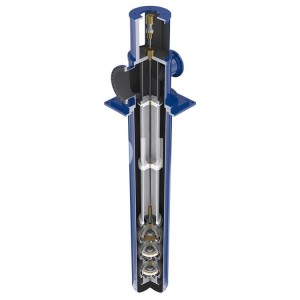
The main reasons for replacing long-shaft submerged pumps with self-priming pumps are as follows: First, the pump body can be installed on the ground or a platform, avoiding prolonged immersion of key transmission components in the medium and reducing the risk of corrosion and wear. Second, self-priming pumps have a certain suction capability, meeting the requirements for pumping liquids from collection pits and sumps while reducing shaft vibration and maintenance difficulties caused by the long-shaft structure. Third, equipment maintenance becomes more convenient, as key components such as mechanical seals, bearings, and motors can be inspected and replaced on the ground, shortening downtime. Fourth, it helps improve on-site safety management levels, reducing the risks associated with personnel entering pits, hoisting long-shaft components, and coming into contact with hazardous media.
From a risk perspective, the main risks of continuing to use long-shaft submerged pumps include mechanical failures caused by shaft vibration, impeller eccentric wear due to guide bearing wear, reduced strength from corrosion of submerged components, safety risks during maintenance and hoisting, and the impact of sudden pump failures on the stable operation of device drainage, wastewater transport, or emergency liquid collection systems. If the medium being transported is flammable, corrosive, or toxic, there may also be risks of leakage, environmental pollution, and production safety incidents.
After converting to self-priming pumps, new technical risks must also be carefully controlled First, the self-priming height, suction pipeline length, net positive suction head (NPSH), and start-up priming conditions should be verified to ensure the self-priming pump can stably establish a vacuum and reliably draw liquid. Second, the suction pipeline must be sealed to prevent air leaks that could cause self-priming failure. Third, appropriate materials for flow-wetted parts, mechanical seal types, and flushing schemes should be selected based on the medium's corrosiveness, solid content, and temperature. Fourth, reasonable measures such as foot valves, check valves, liquid level interlocking, dry-run protection, anding should be implemented to prevent dry running, cavitation, and frequent start-stop cycles.
Overall, this rectification is highly necessary. Converting long-shaft submerged pumps to self-priming pumps helps eliminate the inherent risks of vibration, corrosion, maintenance difficulties, and safety hazards associated with the long-shaft submerged structure, improving equipment operational reliability and maintenance convenience. As long as suction conditions, pipeline sealing, material selection, and automatic protection measures are fully considered during the design phase, this rectification plan offers good safety, economy, and feasibility, meeting the requirements for long-term stable operation of petrochemical devices and safety hazard remediation.
Jiangsu Haifa Machinery Manufacturing Co., Ltd. was restructured from Jiangsu Ligong Group Co., Ltd. (founded in 1958) and the Jingjiang Stainless Steel Pump and Valve Factory of the Iron and Steel Research Institute of the Ministry of Metallurgical Industry. The company primarily produces API610 chemical process pumps—OH1, OH2, OH3, OH4 pumps, BB1, BB2, BB3, BB4, BB5 multistage pumps, VS1, VS4, VS5, VS6 barrel casing pumps, HES-type chemical process pumps, chemical pumps, petrochemical pumps, sixth-generation ultra-low carbon steel high-quality leak-free molten urea pumps, urea hydrolyzer feed pumps, high-temperature asphalt pumps, pitot tube pumps, rotary jet pumps, low-flow high-head pumps, multistage vortex pumps, high-temperature molten salt pumps, high-temperature nitric acid pumps, submerged pumps, magnetic drive pumps, low-temperature liquid hydrogen and methanol pumps, high-pressure liquid hydrogen pumps, high-temperature nitric acid magnetic drive pumps, magnetic drive pumps for conveying solid-containing media, industrial pumps, canned motor pumps, slurry pumps, titanium tetrachloride pumps, strong self-priming pumps, lined fluorine pumps, sandwich-lined fluorine pumps, leak-free pumps, desulfurization and denitrification pumps, alkali pumps, pumps, geothermal pumps, oil pumps, flow pumps, printing and dyeing pumps, dyeing and finishing pumps, Ti alloy pumps, C-276 material, Hastelloy, 316L, forced circulation pumps, fourth-generation nuclear pumps, nuclear island pumps, filter press-specific pumps, refrigerant pumps, long-shaft submerged pumps, CQC first-level energy efficiency chemical pumps, high-pressure descaling industrial pumps, and Chinese chemical pumps. www.jslgpump.com Contact: 13905263417 E-mail: jslgpump@gmail.com E-mail: jsareva@163.com
上一篇:"Lieyan-2" electric cycle rocket engine: reshaping the propellant supply method of electric cycle liquid launch vehicles with electric pumps 下一篇:Interpretation of Chemical Pump Applications from the Perspective of the "2026 White Paper on China's Industrial Assembly and Fastening Industry"
Jiangsu Haifa Machinery Manufacturing Co., Ltd.
📍 Headquarters: Jingjiang Economic and Technological Development Zone, Jiangsu Province (Yangtze River Delta Ecological Green Integration Demonstration Zone, Jingjiang Park)
📞 Hotline: (086)13905263417 & (086)13908365805
📠 Fax: (086)0523-84323581
📧 Email: jsareva@163.com jslgpump@gmail.com
🔧 Technical Support: One-stop service for pump & valve customization, non-standard design, on-site surveying, maintenance and repair
Member of China General Machinery Industry Association | Director of Valve Association | SINOPEC Resource Market Member Factory

Get QR Code