
Application of Lingsheng supercomputer in remote automatic control of water pumps: Technical considerations for Jiangsu Haifa API610 chemical process pumps
2026-06-24 18:12:03 576 江苏海珐As a technical professional long engaged in the design, selection, and field service of API610 chemical process pumps, my understanding of remote automatic control for pumps is not simply about "remote start-up and remote shutdown." For continuous production systems such as oil refining, petrochemicals, coal chemicals, urea plants, fine chemicals, thermal power, seawater desalination, and environmental water treatment, the core issues that pump automatic control must address are safe operation, stable delivery, energy saving and consumption reduction, and early warning. In recent years, the demand for intelligent pump stations, remote operation and maintenance, predictive maintenance, digital twin pump stations, and automatic control systems for API chemical process pumps has significantly increased in industrial settings. The emergence of high-performance computing platforms like the Lingsheng Supercomputer provides a new technical foundation for remote automatic control of pumps. Its value lies not in replacing on-site PLCs, DCS, or variable frequency control cabinets, but in combining vast amounts of operational data, simulation models, and AI algorithms to gradually shift pump control from "empirical judgment" to "data-driven judgment."
I. The Most Important Thing for Remote Control of Chemical Process Pumps is First Understanding the Working Conditions
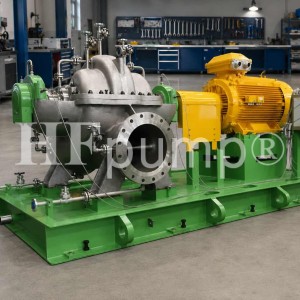
When we select API610 chemical process pumps, our primary focus is always on the medium, flow rate, head, temperature, pressure, Net Positive Suction Head (NPSH), density, viscosity, corrosiveness, and solid content. The same applies to remote automatic control systems. If the system only collects current and discharge pressure without analyzing suction pressure, bearing temperature, vibration, seal flush status, medium temperature, and changes in the pump's operating point, it only be considered ordinary monitoring, not true intelligent control.
Take Jiangsu Haifa's API610-OH2 type HES series chemical process pump as an example. This series of pumps is a horizontal, radially split, single-stage overhung centrifugal pump, designed and manufactured according to the API610 standard. It can be equipped with various auxiliary and monitoring systems and is suitable for oil refineries, petrochemicals, low-temperature engineering, coal chemicals, chemical fibers, power plants, environmental engineering, offshore industries, and seawater desalination. Its main technical ranges include:
Flow range: 2~2600 m³/h
Head range: approximately 300 m
Applicable temperature: -80~450°C
Design pressure: 2.5 MPa~26 MPa
From these parameters, it is clear that API610 chemical process pumps do not handle ordinary clean water conditions but rather complex conditions involving high temperature, high pressure, low temperature, corrosion, flammability, explosiveness, and continuous operation. When such equipment is integrated into a remote automatic control system, the pump body design, seal system, bearing system, piping system, and control logic must be considered together.
II. What Can the Lingsheng Supercomputer Bring to Remote Pump Control?
The Lingsheng Supercomputer represents capabilities in high-performance computing, engineering simulation, AI training, and large-scale data processing. Applied to the field of remote automatic pump control, I believe it can primarily play five roles.
First, it can establish pump operational data models. Every pump on-site generates a large amount of data daily, including suction pressure, discharge pressure, flow rate, motor current, bearing temperature, pump casing temperature, vibration velocity, seal flush pressure, cooling water status, VFD frequency, and valve opening. In the past, most of this data was merely recorded, with little used for actual analysis. By uploading this data to a data platform via edge gateways and using high-performance computing for modeling, an operational profile for each pump can be created.
Second, it enables comparison between performance curves and actual working conditions. Pumps have performance curves at the factory, but on-site operation is affected by piping resistance, valve opening, medium viscosity, temperature changes, impeller wear, cavitation, and scaling. Through computing platforms like Lingsheng, the pump's design curve, test curve, and on-site operating points can be compared over the long term to determine if the pump is operating outside its high-efficiency zone or is persistently in a low-flow, low-efficiency, or cavitation-risk range.
Third, it facilitates fault prediction. For API610 chemical process pumps, common issues include bearing temperature rise, mechanical seal leakage, excessive vibration, impeller wear, cavitation, suction strainer blockage, coupling misalignment, and piping stress effects. Traditional maintenance often addresses faults only after they occur. However, by combining remote automatic control with AI analysis, abnormal trends can be identified. For example, a slight increase in vibration, a slow rise in bearing temperature, increased current fluctuation, or unstable discharge pressure might not be significant individually, but comprehensive analysis could indicate that the equipment is entering an abnormal state.
Fourth, it optimizes multi-pump parallel operation variable frequency operation. Many chemical plants, circulating water systems, water supply systems, and forced circulation systems use multiple pumps in parallel. Decisions on when to run one pump versus two, when to switch to a standby pump, and how to adjust the VFD frequency cannot be based solely on instantaneous flow rate. Efficiency, head, NPSH, and power consumption must also be considered. A supercomputing platform can calculate more reasonable operational schemes based on historical data and real-time conditions, reducing inefficient operating time.
Fifth, it supports digital twin pump stations. A digital twin is not just about creating a visually appealing 3D model; it involves synchronizing the equipment parameters, piping parameters, control logic, and operational data of the real pump station into a virtual model. This allows for predicting changes in pressure, flow, vibration, and energy consumption within the model before making adjustments to valves, switching pump sets, or changing frequencies on-site, thereby reducing the risk of operational errors.
III. Key Parameters to Monitor When Integrating API610 Pumps into Remote Automatic Control
From a technical perspective, remote automatic control of pumps should not just focus on "whether it can start." The parameters that truly need monitoring fall into the following categories:
Process Parameters: Flow rate, head, suction pressure, discharge pressure, medium temperature, medium density, viscosity, vapor pressure.
Mechanical Parameters: Bearing temperature, bearing vibration, pump casing vibration, axial displacement, coupling status.
Seal Parameters: Seal chamber pressure, flush pressure, cooling water flow rate, leakage trend, status of API682 seal support systems.
Electrical Parameters: Motor current, voltage, power, power factor, VFD frequency, motor temperature rise.
Operational Status: Number of start/stops, continuous running time, standby pump switching cycle, alarm records, maintenance records.
Once this data is uploaded, the Lingsheng Supercomputer can be used for large-scale data analysis and model training, while the on-site PLC/DCS handles the execution of specific control commands. This ensures the real-time nature of on-site control while leveraging the supercomputing platform's strengths in analysis, prediction, and optimization.
IV. Different API610 Pump Types Have Different Remote Control Priorities
The API610 chemical process pumps manufactured by Jiangsu Haifa include OH1/OH2, BB1~BB5, VS series, HES type chemical process pumps, molten urea pumps, urea hydrolyzer feed pumps, molten salt pumps, vertical sump pumps, high-temperature magnetic drive pumps, canned motor pumps, and forced circulation pumps. The priorities for remote control differ among these pump types.
For the API610-OH2/HES chemical process pump, the focus of remote control is on maintaining a stable operating point, monitoring bearing temperature and vibration, and ensuring the seal flush scheme is normal. This series has a flow range of 2~2600 m³/h, head around 300 m, applicable temperature -80~450°C, and design pressure 2.5 MPa~26 MPa, suitable for complex chemical media transport.
For the API610-OH2-HES(X) low-flow, high-head chemical process pump, with a flow range of 0.8~12.5 m³/h, head range of 12~125 m, applicable temperature -80~450°C, and design pressure around 2.5 MPa. Low-flow pumps are most susceptible to prolonged operation away from their design point. Therefore, the remote control system must pay special attention to the minimum continuous stable flow, discharge pressure fluctuations, and seal status.
For the API-BB2 HFDD heavy-duty petroleum and chemical process pump, with a flow range of 50~4000 m³/h, head around 650 m, applicable temperature -80~450°C, and design pressure 5.0 MPa~15.0 MPa. BB2 pumps are often used in oil refining, petrochemicals, coal chemicals, crude oil transport, and high-temperature tower bottom applications, requiring high continuous operation reliability. The control system should focus on monitoring vibration, bearing temperature, suction conditions, and the impact of piping stress on pump operation.
For the API-BB4 HCS horizontal multistage centrifugal pump, with a flow rate up to approximately 500 m³/h, head up to 1000 m, applicable temperature -80~180°C, and design pressure around 15.0 MPa. Multistage pumps have high head, so the control system must prioritize monitoring inter-stage pressure, axial thrust, start/stop surges, discharge pressure protection, and the stability of VFD regulation.
For the API610-HES(U) ultra-low carbon stainless steel high-quality molten urea pump, which primarily handles Urea melt, a medium characterized by high temperature, easy crystallization, corrosiveness, and significant operating condition fluctuations. This pump uses API610-OH2 technical parameters, with flow-wetted parts capable of hot water, thermal oil, or steam tracing, and features dead-zone-free design and optimized internal flow paths at critical locations. In such conditions, the remote control system must pay special attention to tracing temperature, seal reliability, anti-crystallization status, and the logic for purging and tracing after shutdown.
V. Recommended System Architecture for Remote Automatic Control
I believe the integration of API610 chemical process pumps with the Lingsheng Supercomputing platform can be understood through the following architecture:
Field Device Layer: API610 chemical process pump, motor, VFD, mechanical seal support system, cooling system, lubrication system, valves, and instruments.
Data Acquisition Layer: Pressure transmitters, flow meters, temperature sensors, vibration sensors, current acquisition modules, level gauges, leak detection instruments.
Control Execution Layer: PLC, DCS, VFD control cabinet, interlock protection system, emergency shutdown system.
Edge Computing Layer: Industrial gateways, local data caching, preliminary anomaly detection, offline protection.
Platform Analysis Layer: Lingsheng Supercomputer, high-performance data analysis, AI model training, digital twin simulation, operational strategy optimization.
Remote Operation & Maintenance Layer: PC terminals, mobile terminals, centralized control center, alarm push notifications, equipment archives, maintenance recommendations.
In this architecture, on-site control must prioritize safety interlocks. The supercomputing platform should not bypass on-site protection logic to directly operate equipment. Instead, it provides operational recommendations, alarm judgments, maintenance plans, and optimization strategies based on its computational results. This better aligns with the safety requirements of chemical plants.
VI. Application of Lingsheng Computing Power in Energy-Efficient Operation
Pumps are major energy consumers in industrial plants. High energy consumption on-site is often not due to poor pump quality, but rather unreasonable long-term operating points. Examples include significant deviation between design flow and actual flow, long-term throttling by the discharge valve, prolonged low-efficiency operation, or suboptimal combinations of pumps operating in parallel.
By analyzing vast amounts of operational data using the Lingsheng Supercomputer, the optimal operating combination for different conditions can be determined. For instance, using a single VFD-driven pump during low-load periods and two pumps in parallel during high-load periods; for high-head systems, automatically adjusting the frequency based on pressure demand to avoid energy waste from valve throttling; for circulating systems, automatically adjusting the pump set based on changes in temperature, level, and process load. This control method can pump station operational efficiency and help customers reduce long-term operating costs.
For API610 chemical process pumps, energy saving is not simply about reducing speed. It involves finding a more suitable operating point while ensuring process safety, NPSH requirements, seal lubrication, minimum flow, and piping stability.
VII. Significance for Jiangsu Haifa API610 Chemical Pumps
From a manufacturer's perspective, the application of the Lingsheng Supercomputer in remote automatic pump control is not just about adding an "intelligent" label to the product. It drives the transformation of chemical pumps from individual equipment to system-level services. In the past, customers primarily considered flow, head, materials, price, and delivery time when purchasing pumps. Now, many customers are more concerned about whether the equipment can operate stably for the long term, reduce unplanned shutdowns, detect faults early, lower energy consumption, and maintain reliable operation under unattended or minimally attended conditions.
Jiangsu Haifa Machinery Manufacturing Co., Ltd. has long produced API610 chemical process pumps, corrosion-resistant pumps, high-temperature pumps, forced circulation pumps, molten urea pumps, molten salt pumps, vertical sump pumps, magnetic drive pumps, and other products. In the future, by combining our pump design experience, field service experience, pump performance curves, fault case studies, and customer on-site operational data, and then integrating this with a high-performance computing platform, we can form a more comprehensive intelligent pump operation and maintenance solution. This solution holds practical value for oil refineries, coal chemical plants, urea plants, chemical fiber plants, environmental water treatment, seawater desalination, thermal power plants, and large circulating water systems. It can help customers achieve remote monitoring, automatic control, anomaly alarming, predictive maintenance, energy-saving optimization, and full lifecycle equipment management.
VIII. Conclusion
In my view, the true core of applying the Lingsheng Supercomputer to remote automatic pump control is not "how much computing power it has," but whether that computing power can be effectively applied to specific working conditions. For API610 chemical process pumps, intelligent control only has practical meaning when the pump's structure, materials, seals, bearings, piping, process medium, and control system are analyzed together.
Jiangsu Haifa has accumulated significant field experience with products like API610 chemical process pumps, OH2 pumps, BB2 pumps, BB4 multistage pumps, molten urea pumps, and high-temperature corrosion-resistant pumps. We are more inclined to proceed from an engineering reality perspective, implementing remote automatic control, digital twins, predictive maintenance, and energy-efficient operation for every pump, every pump station, and every continuous production unit.
In the future, competition in the pump industry will not be limited to the manufacturing capability of a single pump. It will extend to intelligent selection, remote control, operational optimization, and full lifecycle services. For an API610 chemical process pump manufacturer like us, the Lingsheng Supercomputer, representing domestic high-performance computing power, provides a new direction for the intelligentization of pump equipment and offers new technical support for Chinese chemical equipment to move towards high reliability, high efficiency, and digitalized operation and maintenance.
API610 chemical process pump, API610 pump, chemical pump, remote automatic control, pump remote monitoring, intelligent pump station, Lingsheng Supercomputer, predictive maintenance, digital twin pump station, Jiangsu Haifa Machinery Manufacturing Co., Ltd., OH2 pump, BB2 pump, BB4 multistage pump, molten urea pump, corrosion-resistant pump.
上一篇:Analysis of the causes of pressure fluctuation, vibration, and noise in centrifugal pumps: field experience from Jiangsu Haifa 下一篇:How to choose between a canned pump and a magnetic pump? Discussing the selection of leak-free pumps from the perspective of chemical process pump technology
Jiangsu Haifa Machinery Manufacturing Co., Ltd.
📍 Headquarters: Jingjiang Economic and Technological Development Zone, Jiangsu Province (Yangtze River Delta Ecological Green Integration Demonstration Zone, Jingjiang Park)
📞 Hotline: (086)13905263417 & (086)13908365805
📠 Fax: (086)0523-84323581
📧 Email: jsareva@163.com jslgpump@gmail.com
🔧 Technical Support: One-stop service for pump & valve customization, non-standard design, on-site surveying, maintenance and repair
Member of China General Machinery Industry Association | Director of Valve Association | SINOPEC Resource Market Member Factory

Get QR Code