
How to choose between a canned pump and a magnetic pump? Discussing the selection of leak-free pumps from the perspective of chemical process pump technology
2026-06-27 19:06:37 603 江苏海珐At chemical plant sites, we often encounter customers making requests like this: the medium is toxic,orous, flammable, explosive, the pump must not leak, and it's best not to use ordinary mechanical seals. When faced with such operating conditions, many people's first reaction to choose a leak-free pump, typically the canned motor pump and magnetic drive pump. I am a technical staff member at Jiangsu Haifa Machinery Manufacturing Co., Ltd., and I usually deal with API610 chemical process pumps, OH2 petrochemical process pumps, BB series high-pressure process pumps, VS series vertical pumps, urea pumps, urea hydrolyzer feed pumps, and low-flow, high-head pumps. When we select chemical pumps for users, we don't simply say "use a magnetic drive pump for toxic media" or "use a canned motor pump for leak-free applications." Instead, we consider the medium,, pressure, flow rate, head, net positive suction head (NPSH), on-site installation conditions, and maintenance habits together. Both canned pumps and magnetic drive pumps are leak-free pumps, but their structural concepts differ, and they are suitable for different operating conditions. Choosing the wrong one can lead to low efficiency, high temperature rise, demagnetization of the inner magnetic rotor, bearing wear, liquid ingress into the stator chamber, pump seizure, or even disruption of the entire chemical plant's continuous operation.
First, Look at the Basic Differences Between the Two Pumps
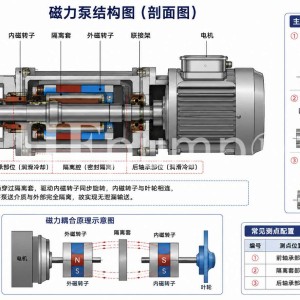
A magnetic drive pump transmits torque through inner and outer magnetic rotors, with no through-shaft seal between the motor and the pump. The medium is enclosed by a containment shell within the pump chamber, allowing for no dynamic seal leakage during normal operation. advantages of a magnetic drive pump include a relatively intuitive structure, easy maintenance, and a standard motor, making it suitable for conveying many corrosive, flammable, explosive, toxic, and odorous media. A canned motor pump integrates the motor and pump into one unit, with the rotor and stator separated by a can. The pumped medium participates in cooling the motor internally and lubricating the bearings. It has no coupling and no ordinary mechanical seal, resulting in a compact overall structure with fewer leak points, making it suitable for applications with extremely high leakage requirements, limited on-site space, a desire for long-term continuous operation. Simply put: a magnetic drive pump is more a "standard motor + magnetic drive + leak-free pump head." A canned motor pump is more like a "fully enclosed, leak-free unit integrating motor and pump." Therefore, the choice between the two should not be based solely on the name but on whether the operating conditions suit their structural characteristics.
Step One: First, Clarify the Medium Properties
When selecting a leak-free pump, the first thing is not to look at flow rate and head but at the medium. We usually ask users for the following parameters: What is the medium name What is the concentration? What is the temperature? What is the density? What is the viscosity? Is it flammable or explosive? Is it, odorous, or volatile? Does it contain particles, crystals, polymers, or impurities? Is it prone to vaporization? Will it crystallize or solidify after the pump stops? Is it sensitive to moisture, air, or temperature rise? If the medium is a clean liquid with low viscosity, no particles, and no crystals, both magnetic drive pumps and canned motor pumps can be considered as leak-free options. If the medium is prone to crystallization, contains particles, iron filings, or salt crystals, selection must be cautious. Both magnetic drive pumps and canned motor pumps have internal sliding bearings, clearance flow paths, and cooling/lubrication circuits. Particles entering can easily cause bearing wear, flow path blockage, and rotor seizure. For such media, we sometimes recommend users switch to API610 chemical process pumps with API682 mechanical seal arrangements, or adopt auxiliary measures like external flushing, heat tracing, jacketing, or filtration, rather than blindly pursuing a "leak-free pump."
Step Two: Look at – Temperature Determines Many Factors
Temperature is one of the dividing points selecting canned motor pumps and magnetic drive pumps. For magnetic drive pumps, on the temperature rating of the magnetic material and the temperature rise of the containment shell. If the temperature is too high, the magnetic material may demagnetize, reducing torque transmission capability. This is especially true for high-temperature heat transfer oils, high-temperature hydrocarbons, molten salts, and molten urea. Don't just look at the maximum temperature on the datasheet; consider the magnetic material, containment shell material, method, and actual operating temperature rise. For canned motor pumps, focus on the motor winding insulation class, can material, medium cooling capacity, and bearing lubrication conditions. Since the medium participates in cooling the motor internally, if the medium itself has a high temperature, low specific heat, or high vaporization pressure, controlling the internal temperature rise of the canned motor pump is critical. In our company's design of API610 chemical process pumps, we typically select materials comprehensively based on medium temperature, pressure,rosiveness, and cavitation conditions. Taking our high-temperature special condition product as an example, the HES(U) ultra-low carbon stainless steel high-quality molten urea pump's published technical range covers flow rates of 2 2600 m³/h, heads up to 300 m, applicable temperatures from -80 to 450°C, and design pressures from 2.5 to 26 MPa. This parameter range indicates that for high-temperature, high-pressure, easily crystallized, and highly corrosive media, the pump design focus is no longer just " it can rotate," but on axial thrust control, anti-crystallization design, insulation structure, material stability, and long-term operational reliability. Therefore, under high-temperature conditions, I generally don't directly ask users to choose between canned motor pump and a drive pump. Instead, I first determine: Will the medium vaporize? Can the internal circulation fluid remove heat? Can the magnetic material or windings withstand the temperature? Will it crystallize after? Is a jacketed, steam-traced, or heat transfer oil-traced insulation needed? Is external cooling water or flushing fluid allowed on site? Without confirming these issues, conclusions about canned motor pumps and magnetic drive pumps cannot be drawn lightly.
Step Three: Look at Pressure and Head – Don't Just Focus on "Leak-Free"
The key component of a magnetic drive pump is the shell. The containment shell must withstand pressure while minimizing eddy current losses. The higher the pressure, the more critical the containment shell. Under high-pressure conditions, if the containment shell's thickness, material, weld quality, and corrosion resistance are not guaranteed, safety can be compromised. For canned motor pumps, consider the pump casing pressure rating, motor chamber pressure rating, can strength, and overall pressure boundary. This is especially true for toxic, flammable, and explosive media; failure of the pressure boundary can have far more serious consequences than with ordinary water pumps. For API610 chemical process pumps, the conditions we often encounter are not simple low-pressure circulation but continuous process conveying in refineries, petrochemical plants, coal chemical plants, fine chemical plants, fertilizer plants, and environmental tail gas treatment units. User-provided parameters typically include normal flow rate, rated flow rate, head, suction pressure, discharge pressure, operating temperature, design temperature operating pressure, design pressure, NPSHa, density, viscosity, corrosiveness, and explosion-proof rating. If the flow rate is low and the head is high, a magnetic drive pump, verify whether the magnetic coupling torque is sufficient to prevent overload and decoupling. If the pressure is high, temperature is high, and the medium is highly hazardous, for a canned motor pump, also verify motor cooling and internal circulation flow. A leak-free pump is not simply a standard centrifugal pump with the mechanical seal removed; it is a complete system integrating thermal, mechanical, electrical, and material aspects.
Step Four: Look at NPSH and Suction Conditions
Many leak-free pump failures are not due to selecting the wrong pump type but to poor suction conditions. Neither magnetic drive pumps nor canned motor pumps cavitation well. Cavitation can cause vibration, noise, flow reduction, bearing damage, and rotor instability. For canned motor pumps, cavitation can also affect internal cooling and bearing lubrication. For magnetic drive pumps, cavitation and dry running can cause dry friction in sliding bearings, excessive temperature rise, and in severe cases, damage to the inner magnetic rotor and containment shell. Therefore, during selection, we must calculate NPSHa and NPSHr, especially under the following conditions: low tank liquid level; medium near its boiling point; long suction piping; high suction filter resistance; insufficient suction valve opening; negative suction head; high-temperature condensate; light hydrocarbons, methanol, ammonia water, or solvent media. If NPSHa is insufficient, I generally recommend users optimize suction conditions first, such as raising liquid level, increasing suction pipe diameter, reducing elbows and valves, lowering suction filter resistance, shortening the suction line, or switching to a vertical pump or tank-mounted installation if necessary, rather than forcing a choice of a particular leak-free pump.
Step Five: Check if the Medium Contains Particles or is Prone to Crystallization
This point is very important. Most magnetic drive pumps and canned motor pumps are better suited for clean liquids. This is because they have internal sliding bearings, bushings, containment shell clearances, and cooling/lubrication channels. If the medium contains particles, crystals, or hard impurities, it can easily wear bearings or block internal circulation paths. For example: salt-containing crystallizing liquids require insulation and anti-crystallization measures; catalyst powder requires wear resistance considerations; rust and weld slag require filtration; easily polymerizing media require consideration of post-shutdown blockage; high-viscosity media require consideration of internal circulation and heat dissipation capacity. If the user's on-site medium is not clean, I usually remind them: a leak-free pump is not a universal pump. For media containing particles, crystals, or with high viscosity, sometimes choosing an API610-OH2 chemical process pump with a double mechanical seal and PLAN 53A/53B/54 seal system is more reliable than blindly using a magnetic drive pump or canned motor pump.
When to Prioritize Magnetic Drive Pumps?
Based on our selection experience, magnetic drive pumps can be prioritized under the following conditions: First, the medium is clean with no obvious particles or crystals. Second, the medium is toxic, odorous, flammable, explosive, and leakage is not allowed. Third, the temperature is within the allowable range for the magnetic material and containment shell. Fourth, flow rate and head are not extremely high, and the magnetic coupling torque is sufficient. Fifth, the user prefers relatively convenient later maintenance, with a standard motor type. Sixth, the site has high leak-free requirements but prefers a less complex equipment structure. For example, clean media like methanol, ethanol, acetone, benzene, light solvents, acid-base solutions, and some organic solvents, if temperature, pressure, and NPSH are suitable, magnetic drive pumps are a common-free solution. However, when selecting a magnetic drive pump, be sure to note: no dry running; no prolonged low-flow operation; no overloading the magnetic coupling; do not ignore containment shell temperature rise; not allow particles to enter sliding bearings; do not select the pump based solely on motor power; verify the magnetic drive torque.
When to Prioritizeanned Motor Pumps?
Canned motor pumps can be prioritized under the following conditions: First, the medium is highly hazardous with extremely strict leakage control requirements. Second, the site requires a compact structure with no coupling or exposed rotating parts. Third, the unit operates continuously, aiming to reduce external seal maintenance. Fourth, the medium is clean and can meet internal cooling and bearing lubrication requirements. Fifth, the site allows for a specialized canned motor structure and can accept the corresponding maintenance methods. Sixth, low noise, full enclosure, and minimal maintenance are important requirements Canned motor pumps have advantages in conveying high-hazard, valuable, or volatile media, but they have higher requirements for medium cooling capacity and internal circulation conditions. If the is prone to vaporization, has high viscosity, contains particles, or is easily crystallized, canned motor pump selection must be very cautious. A canned motor pump is not simply a "motor with a better seal"; its motor and pump form an integrated system. During selection, motor power margin, winding temperature rise, can material, bearing material, internal circulation method, thermal protection, and monitoring methods must be confirmed. Otherwise, once internal bearings are damaged or the stator chamber is abnormal, repair costs may be higher than for ordinary pumps.
Comparison of Canned Motor Pump and Magnetic Drive Pump Selection
From an on-site usage perspective, I generally differentiate as follows: If the user values maintenance convenience, standard motor compatibility, and ease of pump head repair, and the medium is clean with moderate temperature and pressure, prioritize magnetic drive pumps. If the user values a fully enclosed structure, low leakage risk, low noise, compact installation, and the medium is clean with good cooling conditions, prioritize canned motor pumps. If the medium is high-temperature, high-pressure, easily crystallized, contains particles, has high viscosity, or suction conditions, do not simply apply a-free pump solution; re-evaluate API610 chemical process pumps, double mechanical seals, seal flush plans, insulation structures, and material solutions.
Combining with API610 Chemical Process Pump Approach
Jiangsu Haifa Machinery Manufacturing Co., Ltd. has long focused on the design and manufacture of610 chemical process pumps. Product lines include OH1/OH2/OH3, BB1 to BB5, VS1 to VS6 series HES-type chemical process pumps, as well as molten urea pumps, urea hydrolyzer feed pumps, low-flow high-head pumps, pitot tube pumps, and jet pumps. In our internal selection process, we generally compare leak-free pumps and API610 chemical process pumps on the same operating condition sheet, rather than looking at a single pump in isolation. We focus on verifying the following data: Flow rate Q: normal flow, rated flow, continuous stable flow; Head H: normal head, rated head, system resistance variation; Medium parameters: density, viscosity, temperature, concentration, corrosiveness, volatility; Pressure parameters: suction pressure, discharge pressure, design pressure; Cavitation parameters: whether NPSHa is greater than NPSHr with a reasonable margin; Material selection: pump casing, impeller, shaft sleeve, sliding bearing, containment shell or can materials; Electrical requirements: explosion-proof rating, protection rating, voltage, frequency, site area classification; Operation mode: continuous operation, intermittent operation, standby pump switching, whether dry running is allowed; Auxiliary systems: cooling, insulation, filtration, flushing, monitoring, and interlock protection. Taking our high-temperature special media pump as an example, the HES(U) ultra-low carbon stainless steel high-quality molten urea pump's published parameters cover flow rates of 2 to 2600 m³/h, heads up to 300 m, applicable temperatures from -80 to 450°C, and design pressures from 2.5 to 26 MPa. These parameters indicate that in chemical pump selection, the pump type is only the first step; what truly determines reliability is the material, structure, sealing or leak-free solution, expansion control, axial thrust balance, cavitation control, and-site operation and maintenance conditions.
My Practical Selection Advice for Users
If a user asks me, "Which one should I choose, a canned motor pump or a magnetic drive pump?" I usually don't answer with a model immediately. Instead, I first ask the user to provide a complete operating condition sheet. If the medium is clean,-viscosity, at room or medium temperature, toxic, odorous,, or explosive, I will prioritize magnetic drive or canned motor. If the medium is high-temperature, I will focus on verifying the magnetic material's temperature resistance, canned motor winding temperature rise, containment shell heat dissipation, and medium vaporization risk. If the medium is highly corrosive, I will first check the wetted parts and containment shell or can materials, such as whether stainless steel, duplex steel, Hastelloy, titanium, or fluoroplastic lining is suitable. If the medium contains particles or is prone to crystallization, I will be cautious with leak-free pumps and, if necessary, recommend API610 chemical process pumps with a reliable mechanical seal system. If the operating conditions involve high pressure, low flow, and high head, I will verify the magnetic drive torque and bearing load, and also evaluate low-flow high-head pumps, pitot tube pumps, or multistage pump solutions. If the user's site requires long-term operation, I will consider spare parts, maintenance, monitoring, and interlock protection together, than just pursuing a low purchase price.
Conclusion
Canned motor pumps and magnetic drive pumps are both important choices for leak-free chemical pumps, but they are not universal replacements. A truly reasonable selection must return to judging based on medium characteristics, temperature, pressure, flow rate, head, NPSH, material corrosion, internal cooling, bearing lubrication, and on-site operation mode. When we perform API610 chemical process pump selection, what we fear most is not high user requirements, but operating conditions. As long as the medium parameters and on-site conditions are complete, we can choose a more reliable solution for the user from multiple, including magnetic drive pumps, canned motor, API610-OH2 chemical process pumps, BB series high-pressure process pumps, VS series vertical pumps, and double mechanical seal arrangements. For toxic, hazardous, flammable, explosive, valuable, and highly corrosive media, don't just look at the words "leak-free." Selecting the right pump type, the right materials, and right structure is the true key to reducing leakage risk, minimizing maintenance costs, and ensuring the continuous operation of chemical. Canned motor pumps, magnetic drive pumps, leak-free pumps, leak-free chemical pumps, API610 chemical process pumps, OH2 chemical process pumps, BB series high-pressure process pumps, VS vertical pumps, flammable and explosive media conveying, toxic media conveying, chemical pump selection.
上一篇:Application of Lingsheng supercomputer in remote automatic control of water pumps: Technical considerations for Jiangsu Haifa API610 chemical process pumps 下一篇:How to carry out energy-saving renovation for old pumps? Jiangsu Haifa utilizes CFD simulation to optimize hydraulic efficiency
Jiangsu Haifa Machinery Manufacturing Co., Ltd.
📍 Headquarters: Jingjiang Economic and Technological Development Zone, Jiangsu Province (Yangtze River Delta Ecological Green Integration Demonstration Zone, Jingjiang Park)
📞 Hotline: (086)13905263417 & (086)13908365805
📠 Fax: (086)0523-84323581
📧 Email: jsareva@163.com jslgpump@gmail.com
🔧 Technical Support: One-stop service for pump & valve customization, non-standard design, on-site surveying, maintenance and repair
Member of China General Machinery Industry Association | Director of Valve Association | SINOPEC Resource Market Member Factory

Get QR Code