
Design and production of chemical pumps
2026-04-21 23:51:09 805Design and Production of Chemical Pumps: Evolving in the Balance Between Safety and Efficiency
As the "heart" of process industries, the design and production level of chemical pumps directly impacts the stability of production lines, energy consumption, and intrinsic safety. In recent years, with the global chemical industry transitioning toward green, intelligent, and high-end development, the logic behind the design and production of chemical pumps is undergoing profound transformation.
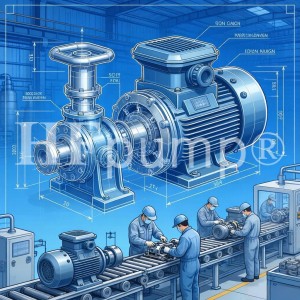
Policy and Market Drivers Elevate Design Standards
Safety and environmental protection are the primary forces driving this change. Globally, regulations addressing hazardous media leaks and volatile organic compounds (VOCs) control are becoming increasingly stringent. This compels chemical pump designs to prioritize reliability, sealing performance, and long-term operational capability. Traditional designs focused more on basic parameters such as flow rate and head, while modern designs must integrate materials science, fluid dynamics, and condition monitoring technologies to cope with extreme operating conditions and stringent environmental requirements. For instance, for media involving high temperatures, strong corrosion, or solid particles, the evolution of pump materials from conventional stainless steel to special alloys, ceramics, and high-performance composites has become a clear trend.
Intelligence Integrated Throughout the Lifecycle
Intelligence has moved from concept to practice, permeating the entire chain of design, production, and operation. On the design front, computational fluid dynamics (CFD) simulations and finite element analysis (FEA) are widely used to optimize hydraulic models, predict cavitation risks, and assess structural strength, significantly reducing physical trial-and-error costs in virtual environments. In production, digital workshops ensure consistency and traceability in the machining precision of critical components. More importantly, intelligence is reshaping maintenance models. By integrating sensors for vibration, temperature, pressure, and other parameters, the operational status of pumps can be monitored and warned in real time. In an intelligent pumping solution we provided for a large fine chemical enterprise in East China, predictive maintenance helped the client reduce unplanned downtime by approximately 30%. This represents not only a product upgrade but also a shift in service philosophy—from "selling equipment" to "providing reliable operational assurance."
Customization and Modularization Coexist
The diversity of chemical processes necessitates highly customized solutions. Whether it’s nuclear-grade pumps, canned motor pumps, or large process pumps, targeted designs are required based on specific media characteristics, installation environments, and process requirements. At the same time, to control costs and shorten delivery times, modular design principles are also gaining popularity. By combining proven standardized functional modules (such as sealing systems and bearing assemblies) with customized hydraulic components, it is possible to meet individualized needs while maintaining production scale effects and quality stability.
Higher Demands on Design and Production Capabilities
These changes impose requirements on chemical pump manufacturers that extend far beyond traditional mechanical processing. Companies must possess deep industry application knowledge to understand customer processes, strong R&D capabilities for material and technological innovation, and the ability to deeply integrate digital tools into every stage from design to service. We observe that some competing solutions still focus merely on meeting parameters, with insufficient consideration for lifecycle operational costs, safety risks, and environmental impacts. In the future, design and production entities capable of deeply integrating hardware reliability, intelligent sensing, and industry-specific process knowledge will occupy a more advantageous position in the competition.
The design and production of chemical pumps are evolving from a purely manufacturing challenge into a systems engineering endeavor that encompasses safety, efficiency, and sustainable development.
上一篇:Trust Jiangsu Haifa: a supplier of high-quality leak-free chemical pumps and pitot tube pumps 下一篇:Medtrum, a leading technology company, shines at the DUK exhibition in Birmingham, where its 300U catheter-free AID pump redefines the freedom of glucose control
Jiangsu Haifa Machinery Manufacturing Co., Ltd.
📍 Headquarters: Jingjiang Economic and Technological Development Zone, Jiangsu Province (Yangtze River Delta Ecological Green Integration Demonstration Zone, Jingjiang Park)
📞 Hotline: (086)13905263417 & (086)13908365805
📠 Fax: (086)0523-84323581
📧 Email: jsareva@163.com jslgpump@gmail.com
🔧 Technical Support: One-stop service for pump & valve customization, non-standard design, on-site surveying, maintenance and repair
Member of China General Machinery Industry Association | Director of Valve Association | SINOPEC Resource Market Member Factory

Get QR Code