
Application analysis of leak-free magnetic drive pump in chemical media containing solids
2026-06-14 19:12:56 212 江苏海珐In the selection of chemical pumps, many people immediately think that magnetic drive pumps cannot be used when they hear "media containing solids." I often encountered this issue when making proposals before: customers wanted leak-free operation but were worried about particles entering the isolation sleeve and sliding bearing area, causing wear, seizure, or demagnetization. Later, we conducted a field application of solid-containing magnetic drive pump at a joint venture chemical plant in Shanghai. This project left a deep impression on me—media containing solids does not necessarily rule out magnetic drive pumps; the key is to consider structure, flow path, materials, flushing, and operating conditions together.
The media at this chemical plant was not clean liquid; it contained a small amount of fine particles and was somewhat corrosive. The customer was initially concerned about mechanical seal leakage because the site had strict requirements for environmental protection and odor control. If a conventional mechanical seal pump were used, maintenance and leakage risks would be high in the long run. So, our approach was not simply to recommend a standard magnetic drive pump but to re-examine the pump's flow-through structure and internal circulation path based on the solid-containing conditions.
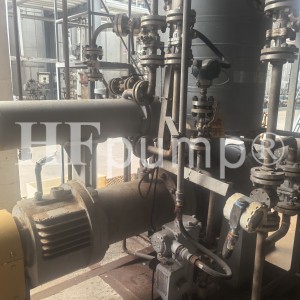
the design, our first focus was whether the particles could pass through smoothly. If the internal circulation channel of a conventional magnetic drive pump is too small, or if there are dead spots near the sliding bearings, solid-containing media can easily deposit, leading to abnormal wear of the shaft sleeve, thrust ring, and sliding bearing over time. To address this, we minimized the risk of clogging in small gaps in the design and optimized the internal circulation cooling and lubrication channels to ensure smoother media flow and prevent particles from staying in localized areas for long periods.
The second key point was materials. Wear from solid-containing media does not happen all at once; it gradually thins the shaft sleeve, wear rings, bearings, and impeller flow path over long-term operation. Based on the customer's media corrosiveness and particle characteristics, we selected flow-through component materials with better corrosion and wear resistance. For more corrosive conditions, we can choose 304, 316L, 2205, 2507, 904L, Alloy 20,elloy, titanium, or other special alloys depending on the actual media. For sliding friction pairs, we prioritize wear-resistant combinations like silicon carbide cemented carbide.
The third key point was the magnetic drive section. The biggest advantage of magnetic drive pumps is the absence of a dynamic seal structure, reducing leakage risk. However, attention must be paid to temperature rise in the isolation sleeve area and the risk of magnet demagnetization. Especially when handling media containing solids, prone to crystallization or deposition, it’s not enough to just look at flow rate and head; media temperature, vaporization pressure, viscosity, particle size, solid content, and on-site start-stop frequency must also be considered. In this project, we calculated magnetic torque, isolation sleeve strength, bearing cooling, and dry-run prevention to ensure the pump didn’t just "run" but operated stably.
After the pump was put into service, the customer reported smooth operation without the significant leakage issues they had feared. For us, the greatest significance of this case is not to prove that all solid-containing media can use magnetic drive pumps, but to show that as long as solid content, particle hardness, particle size, media viscosity, and temperature are within controllable ranges, a well-designed solid-containing magnetic drive pump can replace traditional mechanical seal pumps in some chemical solid-containing applications.
Jiangsu Haifa Machinery Manufacturing Co., Ltd. has long been producing API610 chemical process pumps and leak-free chemical pumps. Our products include API610 OH1, OH2, OH3, OH4, OH6 chemical process pumps, BB1, BB2, BB3, BB4, BB5 multistage pumps, VS1, VS4, VS5, VS6 vertical pumps, HES chemical process pumps, high-temperature magnetic drive pumps, magnetic drive pumps for solid-containing media, canned motor pumps, slurry pumps, titanium tetrachloride pumps molten salt pumps, lined fluoroplastic pumps, and corrosion-resistant chemical pumps.
Taking our API610-OH2-HES(X) small-flow chemical process pump as an example, the product flow range covers 0.8 to 12.5 m³/h, head from 12 to 125 m, applicable temperature from -80 to 450°C, and design pressure up to 2.5 MPa. For larger flow, higher head, or higher conditions, we can recommend BB series, VS series, or customized magnetic drive pump solutions based on site parameters. After the customer provides media, density, viscosity, temperature, pressure, solid content, particle size, corrosiveness, and operating mode, we conduct comprehensive selection considering pump type, materials, magnetic drive, bearing structure, flushing cooling, and installation conditions.
In my field service experience, I’ve always believed that the biggest risk for solid-containing magnetic drive pumps is "selecting based on clean liquid pump logic." If solid-containing media is treated like ordinary clean liquid, wear, clogging, temperature rise, vibration, and internal component damage are likely later on. But if the characteristics are clearly defined upfront, and the impact of solid particles on hydraulics, materials, bearings, and the isolation sleeve is considered, magnetic drive pumps can still deliver leak-free, low-maintenance, and environmentally friendly performance in many chemical sites.
This application at a joint venture chemical plant in Shanghai also gave us a more practical understanding of solid-containing magnetic drive pumps. Chemical pumps are not just about catalog parameters; on-site media is often more complex than data sheets. Through cases like this, we hope to apply Jiangsu Haifa's design experience with API610 chemical process pumps, solid-containing magnetic drive pumps, high-temperature magnetic drive pumps, corrosion-resistant chemical pumps, and leak-free pumps to actual customer installations, helping reduce leakage risks, lower maintenance frequency, and improve the continuous operation capability of chemical units.
上一篇:Design experience of OH2 pump under high temperature and high pressure conditions: Technical sharing of Jiangsu Hafia API610 chemical process pump 下一篇:没有了
Jiangsu Haifa Machinery Manufacturing Co., Ltd.
📍 Headquarters: Jingjiang Economic and Technological Development Zone, Jiangsu Province (Yangtze River Delta Ecological Green Integration Demonstration Zone, Jingjiang Park)
📞 Hotline: (086)13905263417 & (086)13908365805
📠 Fax: (086)0523-84323581
📧 Email: jsareva@163.com jslgpump@gmail.com
🔧 Technical Support: One-stop service for pump & valve customization, non-standard design, on-site surveying, maintenance and repair
Member of China General Machinery Industry Association | Director of Valve Association | SINOPEC Resource Market Member Factory

Get QR Code