
Should a screw pump or a centrifugal pump be chosen for oil-gas multiphase pumps? Jiangsu Haifa discusses pump selection from the perspective of API610 chemical process pumps
2026-06-24 05:57:32 406 江苏海珐In oilfield surface gathering, wellhead boosting, crude oil export, natural gas associated liquid transportation, and offshore platform production systems, a common question arises: should an oil-gas multiphase pump be a screw pump or a centrifugal pump? When selecting API 610 chemical process pumps, we often encounter similar questions from customers. Many field personnel’s first reaction is: isn’t an oil-gas multiphase pump usually a screw pump? This judgment has some merit, but it cannot be generalized. Because the conditions covered by the term “oil-gas multiphase transportation” vary greatly—some involve high gas content, slug flow, and significant fluctuations in gas-liquid ratio at the wellhead; others involve crude oil transportation after preliminary gas-liquid separation; and still others involve liquid-phase-dominated processes such as crude oil, condensate, water-cut oil, light hydrocarbons, and LPG transportation. From our technical experience, selecting an oil-gas multiphase pump should not rely solely on “name”; it must consider gas content, liquid phase ratio, viscosity, inlet pressure, net positive suction head available (NPSHa), flow rate, head, presence of sand, slug flow, continuous operation requirements, and-site maintenance conditions. Screw pumps and centrifugal pumps not simply interchangeable; they suit different boundary conditions.
Why are screw pumps commonly used for oil-gas multiphase transportation?
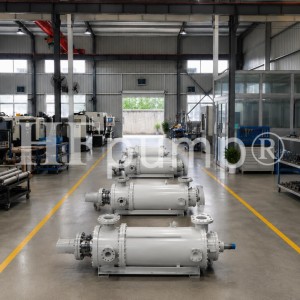
Screw pumps positive displacement pumps. In oil-gas multiphase transportation, twin-screw pumps, singlecrew pumps, and some specially structured multiphase pumps are common. Their characteristic is that the screw and pump cavity form a relatively sealed transport chamber, pushing the medium from the inlet to the outlet. Under conditions of high gas content, high viscosity, low inlet pressure, and large gas-liquid ratio fluctuations, screw pumps indeed have clear advantages. For example, when wellhead fluid contains crude oil, natural gas, water, condensate, and even a small amount of sand, the medium is not a stable single-phase liquid but a gas-liquid mixture. In such cases, directly using a standard centrifugal pump can lead to flow fluctuations, head drop, increased vibration, cavitation, gas locking, or even dry running. The advantages of screw pumps are mainly reflected in several aspects: First, they are more adaptable to gas-containing conditions. During oil-gas multiphase transportation, gas phase ratio often changes, and screw pumps can maintain relatively stable discharge capacity within a certain range. Second, they are suitable for high-vosity media. For heavy oil, emulsified oil, water-cut crude oil, and media with high asphaltene content, centrifugal pump efficiency often drops significantly, while pumps are more tolerant of viscosity changes. Third, they have good suction performance. In wellhead low-pressure or poor inlet conditions, screw are relatively easier to establish suction. Fourth, they can reduce on-site separation equipment. Some oil-gas multiphase projects use screw pumps to minimize the need for gas-liquid separators, compressors, dual pipelines, and other equipment at the well site, directly transporting the unseparated oil, gas, and water mixture to a central processing station. Therefore, from the perspective of “unseparated, high gas content, slug flow, high viscosity, low inlet pressure,” screw pumps are indeed a common and mature solution for oil-gas multiphase transportation.
Screw pumps also have drawbacks
When recommending pump types to users, we do not only highlight the advantages of one type. Screw pumps are suitable for oil-gas multiphase transportation, but there are aspects to note. First, screw pumps require high manufacturing precision, screw profiles, timing gears, mechanical seals, and bearing systems. Especially for twin-screw multiphase pumps, long-term transport of sand-containing media can cause wear on the screws, liners, and seal areas. Second, scaling up screw pump flow is not always economical. For large flow, low-head or medium-head crude oil transportation, product oil transportation, condensate transportation, or process liquid transportation, centrifugal pumps often have advantages in efficiency, equipment cost, maintenance convenience, and spare parts standardization. Third, the operation and maintenance of screw pumps require attention to protection logic, such as dry running time, inlet filtration, lubrication, temperature rise, mechanical seal flushing, bypass protection, and differential pressure control. If on-site management is, issues like seizure, wear, or seal failure may occur. Fourth, screw pumps are generally more suitable for “complex multiphase transportation,” but this does not mean all crude oil, oil products, or gas-containing liquids must use screw pumps. If the medium has undergone gas-liquid separation, or if the gas content is low and stable, using API 610 centrifugal chemical process pumps may be more appropriate.
Can centrifugal pumps be used for oil-gashase transportation?
This question needs to be examined separately. For true high-gas-content oil-gas multiphase transportation—i.e., unseparated oil, gas, and water mixed flow at the wellhead with large gas phase ratio fluctuations and even slug flow—we generally do not recommend using standard API 610 centrifugal pumps to force this condition. Because centrifugal pumps operate based on continuous liquid phase; the impeller transfers energy to the liquid through rotation. When there is too much free gas at the inlet, gas accumulates in the impeller flow channels, causing head drop, unstable flow, increased vibration, and in severe cases, gas locking and flow loss. However, if the condition is liquid-phase-dominated—such as crude oil export, water-cut crude oil transportation, condensate transportation, light hydrocarbon transportation, LPG transportation, oil product transportation in refineries, or liquid phase transportation in natural gas processing plants—and the inlet pressure, NPSHa, gas content, viscosity, and temperature can be controlled, then API 610 centrifugal pumps are fully applicable. When we design API 610 process pumps, we focus more on continuous stable operation. For example, inineries, petrochemical plants, coal chemical plants, natural gas processing plants, offshore platforms, pipeline transportation, oil product transportation, andPG projects, many media come from oil and gas systems but have already achieved clear liquid-phase conditions before entering the pump. In such cases, selecting API 610 pump types like OH2, BB2, BB3, BB4, or VS5/VS6 can achieve a better balance in efficiency, reliability, standardization, and long-term maintenance.
Advantages of API 610 centrifugal pumps in oil and gas related processes
From the perspective of Jiangsu Haifa Machinery Manufacturing Co., Ltd.’s API 610 process pump technical staff, we prefer to position centrifugal pumps as “stable liquid-phase process transport equipment” rather than simply claiming they can replace all oil-gas multiphase pumps. The advantages of API 610 centrifugal pumps are mainly in following areas: First they are suitable for large-flow continuous transportation. For such as crude oil, product oil, condensate, light hydrocarbons, LPG, process water, condensate, lean liquid, and rich liquid, centrifugal pumps typically achieve higher efficiency under large flow conditions., they have a high degree of structural standardization. API 610 pumps have mature design frameworks for pump casing support, bearings, cooling, sealing, vibration, materials, and auxiliary systems, facilitating unified management in refineries, petrochemical plants, natural gas processing plants, and coal chemical plants. Third, their sealing systems are mature. The sealing systems for our API 610 OH1/OH2 HES series chemical process pumps can be configured per API 682, with options for single, double, tandem mechanical seals and corresponding flushing and cooling schemes based on medium properties. For flammable, explosive, toxic, or corrosive media, the sealing scheme is more critical than the pump type alone. Fourth, they are suitable for high-temperature, high-pressure, and long-term continuous operation. Many pumps in oil and gas and petrochemical plants are not for short-term use but require long cycles, low failure rates, and maintainability. API 610 process pumps are designed around such conditions. Fifth, spare parts and maintenance are more convenient. The impeller, shaft, bearings, seals, pump casing, and cover of centrifugal pumps have relatively structures, making them more familiar to on-site maintenance personnel and easier to standardize spare parts management.
Relevant technical parameters covered by Jiangsu Haifa API 610 chemical process pumps
We currently produce API 610 OH1/OH2, BB1, BB2, BB3, BB4 VS5/VS6 series chemical process pumps, as well as special pump types like HXP rotary jet pumps and molten urea pumps. For oil and gas, refining, petrochemical, coal chemical, natural gas processing, and high-temperature high-pressure process transportation, we can select pumps based on user conditions.
API 610-OH2 chemical process pump / OH1/OH2/HES pump
The API-OH1/OH2 HES series petrochemical process pumps are horizontal, radially split, single-stage overhung centrifugal pumps with volute casing, designed and manufactured per API 610 standards, with sealing systems configurable per API 682. Main parameter range: Flow rate: 2 to 2600 m³ Head: up to 300 m Temperature: -80 to 450°C Design pressure: 2.5 to 26 MPa Suitable for clean, low-temperature, or high-temperature media, and can also handle liquids containing particles, slurry, fibers, sewage, high viscosity, neutral or corrosive liquids. This series is suitable for refineries, petrochemical plants, low-temperature engineering, coal chemical plants, chemical fiber plants, power plants, offshore industries, and seawater desalination. In oil and gas related systems, for stable liquid-phase crude oil, condensate, light hydrocarbons, oil products, or process liquid transportation, the OH2 type API 610 chemical process pump is our common selection direction.
API 610-OH2-HES(X) small flow high head chemical process pump
The HES(X) series is a small flow, high head chemical process pump, suitable for conditions with small flow, high head, clean media, or trace particles. Main parameter range: Flow rate: 0.8 to 12.5 m³/h Head: 12 to 125 m Temperature: -80 to 450°C Design: up to 2.5 MPa This pump type has application value in small flow metering, auxiliary processes, seal flushing, and special chemical liquid transportation.
BB1 double suction pump
The API 610-BB1-HASD series is a horizontal, axially split, single-stage or two-stage double-suction centrifugal pump with double-suction impeller, suitable for large flow conditions. Main parameter range: Flow rate: 100 to 11000 m³/h Head: up to 440 m Temperature: -40 to 160°C Design pressure: 2.5 to 5.0 MPa In large flow applications like crude oil transportation, oil transportation, pipeline pressurization, water supply, water treatment, and seawater desalination, BB1 pumps are more economical for continuous transportation than screw pumps.4. BB2 heavy-duty petrochemical process pump The API-BB2 HFDD series is a horizontal, radially split, single-stage, two-stage, or three-stage between-bearing centrifugal pump with centerline support, suitable for severe heavy-duty conditions. Main parameter range: Flow rate: 50 4000 m³/h Head: up to 650 m Temperature: -80 to 450°C Design pressure: 5.0 to 15.0 MPa This series is suitable for oil refining, petrochemical, coal chemical, crude oil transportation, natural gas processing, offshore drilling equipment, and can be used for crude oil pumps, high-temperature tower bottom pumps, and continuous operation in modern refineries.
BB3 horizontal multistage centrifugal pump
The API-BB3 HSSC/HDSC series is suitable for high-pressure, high-head conditions, with impellers that can be arranged symmetrically for good axial force balance. Main parameter range: HSSC single casing flow rate: 10 to 1500 m³/h HDSC double casing flow rate: 45 to 1440 m³/h Head: up to 3000 m / 3200 m Temperature: -40 to 200°C / -80 to 450°C Design pressure: 10 to 35 MPa Design speed: up to 6000 rpm / 9000 rpm This series is suitable for high-pressure applications such as oil extraction, petrochemical, pipeline transportation, coal chemical, seawater desalination, power plants, and oilfield water injection.
BB4 horizontal segmental multistage centrifugal pump
The API-BB4CS series is a horizontal, radially split, segmental multistage centrifugal pump, with centerline or foot support options based on temperature. Main parameter range: Flow rate: up to 500 m³/h Head: up to 1000 m Temperature: -80 to 180°C Design pressure: up to 15.0 MPa Typical applications include boiler feed water, water injection pumps, high-rise building water supply, thermal power plants, refineries, petrochemical plants, and coal chemical plants.
API-VS5/VS6-HVSD vertical multistage centrifugal pump
The API-VS5/VS6-HVSD series is a vertical multistage, radially split pump, suitable for deep liquid levels, high head, easily vaporizing media, and low-temperature media transportation. Main parameter range: Flow rate: 2 to 15000 m³/h Head: up to 1000 m Temperature: -80 to 250°C Design pressure: up to 15 MPa This series can be used inineries, petrochemical plants, coal chemical plants, power plants, low-temperature engineering, pipeline pressure regulation, condensate extraction, LPG projects, offshore platforms, and oil tankers, suitable for media such as ethylene, liquid ammonia, LPG, condensate, hydrogen hydrocarbons, and oil products.
Comparison between screw pumps and centrifugal pumps in oil-gas multiphase transportation
From a practical selection perspective, I would differentiate as follows: If the medium is an unseparated oil-gas-water mixture with high gas phase ratio, large gas-liquid ratio fluctuations slug flow, low inlet pressure, high viscosity, and the site aims to reduce separators and compressors, then screw pumps are more suitable. Especially for wellhead boosting, remote well site gathering, low-pressure gas well liquid drainage, and gas-containing crude oil multiphase transportation, the positive displacement characteristics of screw pumps provide stability. If the has undergone gas-liquid separation, or if the gas content is low and controllable, with good liquid phase continuity, large flow, high efficiency requirements, long cycle, standardized maintenance, and the plant is part of a continuous production system like refining, petrochemical, natural gas processing, or chemical, then API 610 centrifugal pumps are more suitable. For example, crude oil export pumps, tower bottom pumps, light hydrocarbon pumps, condensate pumps, LPG pumps, lean liquid pumps, rich liquid pumps, pipeline pumps, and condensate pumps, centrifugal are often the more economical and mature choice. Simply put, screw pumps solve “multiphase transport capability” and “complex inlet conditions,” while API 610 centrifugal pumps solve “stable process transportation” and “long-cycle high-reliability operation.”
Our suggestion: Do not replace condition judgment with pump type
Oil-gas multiphase pump selection cannot be simply decided by “screw pumps are good” or “centrifugal pumps are good.” Truly reliable selection must first clarify the condition parameters. We typically focus on confirming the following: Medium composition: proportions of crude oil, natural gas, water, condensate, sand Gas phase volume fraction: normal, maximum, and minimum conditions Whether slug flow exists: whether short-term high gas content or near-dry gas impact occurs Viscosity range: viscosity at minimum and maximum temperatures Inlet pressure: normal inlet pressure, minimum inlet pressure, start-up pressure Flow rate and head: normal flow, rated flow, maximum flow NPSHa: whether the available net positive suction head meets pump requirements Sand and particles: particle size, hardness, concentration Operation mode: continuous or intermittent operation Seal requirements: whether flammable, explosive, toxic, or corrosive Site conditions: explosion-proof level, cooling water, flushing fluid, instrumentation monitoring, maintenance space Only after these parameters are clear can we determine whether to use 676 screw pumps, API 610 centrifugal chemical process pumps, or a combination scheme of “front-end gas-liquid separation + API 610 process pump.”
Conclusion
From our perspective as API 610 chemical process pump manufacturers, screw pumps are widely used in oil-gas multiphase transportation because they are better suited for complex multiphase conditions with high gas content, high viscosity, low inlet pressure, and large gas-liquid ratio fluctuations. cannot be denied. However, in liquid-phase-dominated process systems such as refining, petrochemical, natural gas processing, crude oil export, LPG transportation, condensate transportation, and pressurization, API 610 centrifugal pumps still have strong application value. Their advantage is not to handle all gas-liquid multiphase transportation, but to provide higher efficiency, more mature structures, more standardized sealing systems, and reliability suitable for long-cycle operation under stable process conditions. Therefore, we prefer to give users a practical suggestion: For true high-gas-content, multiphase, slug flow wellhead multiphase transportation, prioritize screw pumps; for separated or gas-content-controlled oil products, crude oil, condensate, LPG, and petrochemical process liquid transportation, focus on API 610 OH2, BB2, BB3, BB4, VS5/VS6, and other chemical process pumps. Jiangsu Haifa Machinery Manufacturing Co., Ltd. can perform API 610 chemical process pump selection, non-standard design, material configuration, mechanical seal schemes, and auxiliary system design based on the user’s provided medium, temperature, pressure, flow rate, head, NPSHa, gas content, viscosity, corrosiveness, and on-site installation conditions, providing pump equipment technical solutions for refining, petrochemical, coal chemical, natural gas processing, offshore platforms, high-temperature high-pressure process transportation.Oil-gas multiphase pump, oil-gas multiphase screw pump, oil-gas multiphase centrifugal pump, API 610 chemical process pump, API 676 screw pump, twin-screw multiphase pump, crude oil export pump, wellhead boosting pump, natural gas processing pump, condensate pump, LPG pump, OH2 chemical process pump, BB2 petrochemical process pump, BB3 multistage centrifugal pump, VS6 vertical multistage pump, multiphase pump, oil gas multiphase pump, twin screw pump, API 610 centrifugal pump, API 676 screw pump, crude oil transfer pump, wellhead boosting pump
上一篇:Application of LEWMET nickel-chromium based alloy in chemical pumps: material selection considerations under high-temperature concentrated sulfuric acid and phosphoric acid conditions 下一篇:Cavitation analysis of centrifugal pumps in petrochemical plants: How to select pump types OH2, BB2, and VS6
Jiangsu Haifa Machinery Manufacturing Co., Ltd.
📍 Headquarters: Jingjiang Economic and Technological Development Zone, Jiangsu Province (Yangtze River Delta Ecological Green Integration Demonstration Zone, Jingjiang Park)
📞 Hotline: (086)13905263417 & (086)13908365805
📠 Fax: (086)0523-84323581
📧 Email: jsareva@163.com jslgpump@gmail.com
🔧 Technical Support: One-stop service for pump & valve customization, non-standard design, on-site surveying, maintenance and repair
Member of China General Machinery Industry Association | Director of Valve Association | SINOPEC Resource Market Member Factory

Get QR Code