
Observing the Precise Machining of High-Pressure Common Rail Fuel Pumps and API610 Chemical Pumps from the Perspective of German Sonplas HERO Technology
2026-06-27 19:54:10 628 江苏海珐In the pump manufacturing industry, we often discuss flow rate, head, NPSHr, efficiency, materials, and mechanical seals. However, when it comes to high-pressure, low-flow, long-cycle operating conditions, many issues cannot be resolved by external dimensions alone. A burr in a small hole, a sharp edge at an intersecting hole, or local resistance in an internal flow passage can all affect the pressure stability, flow consistency, and service life of the equipment. Recently, I came across the HERO high-pressure liquid abrasive flow machining technology developed by Sonplas GmbH in Germany. Sonplas is a typical German hidden champion in the industry—not necessarily well-known in the mass market, but with significant technical expertise in high-pressure common rail fuel pumps, fuel injection components, precision internal hole machining, and automated assembly and testing systems. HERO stands for HydroEROsive Machining, which can be understood as high-pressure liquid abrasive flow machining, also known as high-pressure liquid extrusion grinding or hydraulic erosion machining. The core concept of this technology is not complicated: it involves forcing a fluid containing abrasive particles through small holes, intersecting holes, throttle holes, and complex flow passages inside a workpiece under high pressure. As the fluid passes through narrow sections, its velocity increases, and the abrasive particles produce a directional grinding effect on the hole edges and internal burrs, thereby achieving deburring, edge rounding, flow calibration, and internal flow passage finishing. This is not ordinary polishing or simple cleaning; it is a precision method that uses the flow itself to complete the machining. As a technician at Jiangsu Haifa Machinery Manufacturing Co., Ltd., when I look at this technology, I not only consider its application in automotive high-pressure common rail fuel pumps but also think about its inspiration for the manufacturing of API610 chemical process pumps, high-pressure chemical pumps, low-flow high-head pumps, pitot tube pumps, rotary jet pumps, and special media pumps.
Why High-Pressure Common Rail Fuel Pumps Need Processing Technologies Like HERO
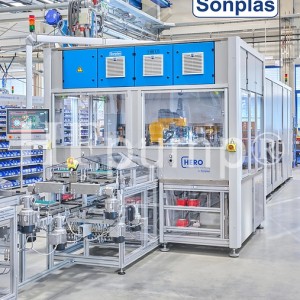
High-pressure common rail fuel pumps are different from ordinary transfer pumps. They operate at high pressures, require high flow control precision, have small internal oil passage diameters, and feature complex part geometries. Many critical areas are not on the external surface but inside the internal holes, intersecting holes, throttle holes, and valve seats. If these areas have burrs, sharp edges, or uneven flow passages, several problems can arise. First, unstable local flow resistance. With the same hole diameter, differences in edge sharpness can lead to variations in actual flow. For high-pressure common rail systems, flow discrepancies affect injection control and pressure stability. Second, a high risk of burr detachment. High-pressure oil flowing over internal burrs over time can cause them to break off, potentially entering valve components, nozzles, or precision clearances, leading to sticking, wear, and leakage. Third, significant stress concentration. Intersecting holes, sharp edges, and micro-notches are prone to stress concentration under high-pressure pulsations, potentially leading to fatigue cracks over long-term operation. Fourth, difficulty in flow calibration. High-pressure common rail fuel pumps require stable flow and pressure response. If internal passages are not consistently calibrated after machining, batch-to-batch part consistency becomes difficult to guarantee. This is where the value of HERO technology lies. It is not about making parts look better, but about using controlled fluid erosion to remove burrs from internal passages, round sharp edges to appropriate radii, and adjust flow within design parameters. For high-pressure common rail fuel pumps, this processing directly impacts pressure stability, flow consistency, and service life.
Differences Between HERO Technology and Traditional MachiningTraditional machining relies on tools such as cutters, drills, reamers, boring tools, and grinding heads. External surfaces and straight holes are relatively easy to handle, but when it comes to internal intersecting holes, deep holes, small holes, and irregular flow passages, tools struggle to reach. Even if machining is possible, secondary burrs are often left behind. The characteristic of HERO technology is that it allows the fluid to enter the internal passages itself. Where flow velocity is high, the grinding effect is strong; where cross-sections contract, the kinetic energy of the abrasive particles is concentrated. This enables machining in areas that traditional tools cannot access. I understand this technology to have three key aspects. First, deburring. Internal burrs are a major enemy of high-pressure components, especially in fuel pumps, nozzles, valve bodies, hydraulic valve blocks, precision throttle holes, and high-pressure oil circuits. HERO can remove internal burrs without damaging the overall structure. Second, edge rounding. Under the erosion of high-pressure media, sharp edges are prone to stress concentration and localized erosion. Forming controlled radii through hydraulic erosion can reduce the risk of cracks and erosion. Third, flow calibration. The flow through a small hole depends not only on its diameter but also on the inlet shape, edge condition, roughness, and passage transitions. During HERO processing, flow changes can be monitored, and machining stops when the target flow is reached, improving flow consistency between different parts. This is also why I believe it has reference value for pump manufacturing. Many critical issues in pumps are essentially problems of energy loss, local impact, cavitation, and wear in complex fluid passages.
Common Logic Between High-Pressure Common Rail Fuel Pumps and Chemical Pump Manufacturing
On the surface, high-pressure common rail fuel pumps and API610 chemical process pumps are not the same type of product. One is used in engine fuel systems, the other for continuous fluid transport in petrochemical, coal chemical, salt chemical, fertilizer, metallurgy, power, and environmental protection equipment. However, from a manufacturing perspective, they share commonalities. First, both must withstand pressure. High-pressure common rail fuel pumps endure high-pressure fuel pulsations, while API610 chemical process pumps bear process media pressure, temperature, and pipeline loads. The higher the pressure, the more critical it is to avoid sharp corners, burrs, and defects in internal transition areas. Second, both emphasize flow passages. High-pressure common rail fuel pumps rely on internal small holes to control flow, while chemical pumps use impellers, volutes, balance holes, seal chambers, cooling flush holes, and internal recirculation passages to control fluid movement. Poor flow passages affect efficiency, vibration, and service life. Third, both are sensitive to particles and burrs. Burrs in high-pressure fuel pumps can damage the injection system; in chemical pumps, casting sand, weld slag, machining burrs, and hard particles can damage mechanical seals, shaft sleeves, sliding bearings, wear rings, and impellers. Fourth, both require stable repeatability. It is not difficult to make one pump that works; the challenge is to make a batch of pumps that all work reliably. Precision machining, inspection, and flow calibration are aimed at improving batch-to-batch consistency. So when I look at HERO technology, I do not simply see it as an automotive parts processing technique, but as a concept of "using fluid to process fluid passages." This concept has reference value for high-pressure chemical pumps, API610 pumps, magnetic drive pumps, canned motor pumps, and low-flow high-head pumps.
Which Areas in API610 Chemical Process Pumps Require Precision Flow Passage Control
Jiangsu Haifa Machinery Manufacturing Co., Ltd. primarily produces API610-OH1/OH2/OH3, BB1–BB5, VS1–VS6 series HES-type chemical process pumps, as well as ultra-high-temperature magnetic drive pumps, canned motor pumps, sixth-generation ultra-low-carbon stainless steel high-quality molten urea pumps, urea hydrolyzer feed pumps, low-flow high-head pitot tube pumps, rotary jet pumps, forced circulation pumps, and desulfurization pumps In these pumps, many areas are not visible external machined surfaces, but they affect long-term operation. For example, impeller balance holes. The function of balance holes is to regulate pressure on both sides of the impeller and reduce axial thrust. If the hole edges have burrs or uneven flow passages, the balance effect is compromised, causing axial thrust fluctuations. For example, seal chamber flush holes. API610 chemical process pumps often require API682 mechanical seal systems, with plans such as PLAN 11, PLAN 23, PLAN 32, PLAN 52, PLAN 53A, PLAN 53B, and PLAN 54 involving flushing, cooling, isolation, and circulation. If flush holes have burrs, blockages, or flow deviations, it can affect seal face temperature and life. For example, cooling water passages and heating jackets. High-temperature media pumps, molten urea pumps, thermal oil pumps, and molten salt pumps require consideration of heat retention, anti-crystallization, and thermal expansion. Dead zones in internal passages can cause localized crystallization, liquid accumulation, or uneven temperature. For example, high-pressure passages in pitot tube pumps and rotary jet pumps. The HXP rotary jet pump, also known as a pitot tube pump, is a low-flow, single-stage high-head, extremely low specific speed pump. It achieves high-pressure head through rotating flow fields and pitot tube energy conversion, demanding higher machining quality for internal passages, nozzles, holes, and high-pressure areas. Burrs or local resistance in these areas can affect high-pressure conversion efficiency. For example, internal circulation holes in magnetic drive pumps and canned motor pumps. These pumps rely on internal circulation fluid for lubrication, cooling, and heat removal. Burrs, blockages, or insufficient flow in internal passages can cause sliding bearing wear, isolation sleeve temperature rise, and inadequate cooling of the canned motor. These areas, though less conspicuous than the pump casing, impeller, or bearing housing, often determine the pump's detail reliability.
Importance of Precision Machining in Relation to Haifa API610 Chemical Pump Parameters
Our API610-OH2 chemical process pump has public parameter ranges covering flow rates of 2–2600 m³/h, heads up to 300 m, applicable temperatures from -80 to 450°C, and design pressures from 2.5 to 26 MPa. This type of pump is mainly used in oil refining, petrochemicals, low-temperature engineering, coal chemicals, chemical fibers, power generation, environmental protection, and seawater desalination, suitable for transporting clean, high-temperature, low-temperature, particle-containing, slurry, fiber-containing, high-viscosity, and corrosive media. This parameter range indicates that API610 chemical process pumps face not single clean water conditions, but high-temperature, high-pressure, strong corrosion, easy vaporization, easy crystallization, and long-cycle operating conditions. The more complex the conditions, the more internal details cannot be ignored. Our HES(U) ultra-low-carbon stainless steel high-quality molten urea pump has public parameters covering flow rates of 2–2600 m³/h, heads up to 300 m, applicable temperatures from -80 to 450°C, and design pressures from .5 to 26 MPa. Molten urea media characteristics of high temperature, easy crystallization, corrosiveness, and significant condition fluctuations, so pump design must consider not only hydraulic efficiency but also anti-crystallization, dead-zone elimination, heat retention, axial thrust control, and seal reliability. Our HXP rotary jet pump/pitot tube pump has public parameters covering flow rates of 1–40 m³/h, heads of 80–1800 m, applicable temperatures from -40 to 150°C, and design pressures up to 26 MPa. For this type of low-flow,-head, high-pressure transfer pump, local resistance in internal passages, hole edge conditions, and machining burrs have a more pronounced impact on efficiency and stability. So in my view, although HERO technology is mainly applied in high-pressure common rail fuel pumps, injection components, and precision hole machining, its underlying concept is connected to API610 chemical pump manufacturing: high-pressure fluid equipment cannot focus only on external strength; internal passage quality must also be controlled.
Inspiration from HERO Technology for Chemical Pump Manufacturing
First, internal passages should shift from "machinable" to "controllable machining." the past, we inspected parts mainly for dimensional compliance, surface roughness, and material requirements. But for high-pressure pumps, internal hole edge quality, intersecting hole rounding, and flow consistency must also enter quality control scope. Second, deburring cannot rely solely on manual work. Manual deburring is suitable for exposed areas, but internal deep holes and intersecting holes are difficult to ensure consistency. For high-pressure common rail fuel pumps, HERO uses fluid abrasives for internal deburring; for chemical pumps, we must also emphasize internal passage cleaning, pickling and passivation, flushing, purging, and borescope inspection. Third, flow passage optimization should be combined with machining processes. CFD simulation can tell us where there areflows, vortices, low-pressure zones, and erosion risks, but if the machining process cannot ensure passage quality, even the best design will be compromised. Design, casting, heat treatment, machining, cleaning, and inspection must be considered together. Fourth, high-pressure pumps must pay attention to micro-defects. The higher the pressure, more dangerous sharp edges, tool marks, burrs, and inclusion defects become. Especially for pumps at 10 MPa, 20 MPa, or higher pressure levels, local small defects may expand under long-term pulsation. Fifth, batch consistency is more important than single-part qualification. A prototype passing inspection does not mean batch stability. HERO technology emphasizes flow calibration and process monitoring, which is also important for pump manufacturing. For example, for the same batch of impellers, balance holes, or flush holes, actual flow and machining conditions should be as consistent as possible.
Applicable Chemical Pump Scenarios for This Technical Concept
Based on our products and field experience, I believe the concepts similar to HERO—high-pressure liquid abrasive flow machining, passage finishing, and precision deburring—can be focused on the following scenarios. First, low-flow high-head chemical pumps. Internal passage dimensions in low-flow pumps are relatively small, so local burrs and hole edge errors have a more significant impact on flow, head, and efficiency. Second, high-pressure pitot tube pumps and rotary jet pumps. These pumps rely on high-speed rotation and energy conversion to achieve high head, demanding high quality in high-pressure passages, nozzles, and internal holes. Third, high-temperature high-pressure API610-OH2 pumps. Under high-temperature and high-pressure conditions, the pump casing, impeller, seal chamber, flush holes, and cooling must avoid stress concentration and flow dead zones. Fourth, BB5 barrel multistage pumps. Internal interstage passages, balance mechanisms, throttle bushings, and balance pipelines in multistage high-pressure pumps are critical, and machining quality affects axial thrust and long-term stability. Fifth, magnetic drive pumps and canned motor pumps. Internal circulation holes, lubrication and cooling passages, and flow conditions near the isolation sleeve directly affect sliding bearing life and temperature rise control. Sixth, molten urea pumps and pumps for easy-cization media. These pumps are most afraid of dead zones, liquid accumulation, and localized crystallization. Reducing sharp corners and dead zones in internal passages helps long-term operation. Seventh, mechanical seal flush systems. Internal burrs in seal flush holes, cooling holes, throttle holes, and pipe fittings affect seal flush effectiveness. For API682 seal systems, flush flow is very important.
HERO Technology Cannot Be Simply Equated with Chemical Pump Manufacturing
It must also be clarified here that the HERO processing technology for high-pressure common rail fuel pumps cannot be directly applied to all chemical pump parts. This is because the part sizes, materials, hole diameters, media, and manufacturing costs differ. High-pressure common rail fuel pump parts are mostly small-hole, high-precision, batch-produced parts. Chemical process pump parts are larger, with more material types, including carbon steel, stainless steel, duplex steel, Hastelloy, titanium, nickel-based alloys, and PTFE-lined materials. Many areas in chemical pumps are not 0.1–5 mm small holes, but large passages, cast passages, impeller passages, and seal chamber structures. So my understanding is that the greatest significance of HERO technology for chemical pump manufacturing is not that all pump parts must be processed with the same equipment, but that it reminds us: the internal passage quality of high-pressure fluid equipment needs to be controlled with more refined machining and inspection methods. For suitable small holes, intersecting holes, throttle holes, flush holes, hydraulic holes, and cooling holes, similar high-pressure liquid abrasive flow finishing processes can be considered. For large passages, quality can be ensured by combining CFD simulation, five-axis machining, precision casting, grinding and finishing, borescope inspection, flow testing, and hydrostatic testing.
What We Should Focus More on in API610 Pump Manufacturing
From Haifa's technical perspective, the inspiration from German Sonplas HERO technology ultimately comes down to manufacturing details. First, the design stage. Unnecessary dead zones, sharp corners, and abrupt cross-section changes should be avoided during design. Impellers, volutes, balance holes, seal chambers, heating jackets, and flush holes should all consider flow smoothness. Second, the machining stage. Critical holes should not only be checked for diameter but also for hole edge quality, burrs, chamfers, roughness, and cleanliness. For high-pressure holes, throttle holes, flush holes, clearer machining and inspection requirements should be established. Third, the cleaning stage. Before pump assembly, internal casting sand, iron filings, weld slag, abrasive particles, and sealant residues must be thoroughly cleaned. Especially for magnetic drive pumps, canned motor pumps, low-flow pumps, and mechanical seal flush systems, cleanliness requirements are higher. Fourth, the inspection stage. In addition to routine dimensional checks, non-destructive testing, hydrostatic testing, dynamic balancing, and performance testing, borescope inspection, flow testing, and pressure holding tests can be performed on critical passages. Fifth, the field operation stage. Users should also pay attention to inlet filtration, pipeline cleaning, start-up flushing, seal flush fluid quality, and media cleanliness. Even if the pump manufacturer makes good parts, if there are weld slag and iron filings in the field, the pump can still be damaged.
Direction for Domestic High-End Pump Manufacturing from German Hidden Champion Technology
My biggest impression of German manufacturing is not that a particular piece of equipment is mysterious, but that they are willing to make very small process details measurable, repeatable, and traceable. HERO technology may seem to only deal with small holes and edges, but it addresses the long-term reliability of high-pressure fluid components. For Chinese API610 chemical process pumps to continue improving international competitiveness, we must also start with these details. We not only need to be able to make large-flow, high-head, high-temperature, high-pressure pumps, but also achieve more stable impeller passages, seal chambers, flush holes, balance holes, cooling holes, internal hole burrs, casting cleanliness, and passage consistency. Jiangsu Haifa Machinery Manufacturing Co., Ltd. has long focused on corrosion-resistant pumps, high-temperature pumps, high-pressure pumps, and API610 chemical pumps for industries such as petrochemicals, coal chemicals, salt chemicals, fertilizers, metallurgy, power, and environmental protection. Our products cover API610-OH2 chemical process pumps BB series high-pressure pumps, VS series vertical pumps, ultra-high-temperature magnetic drive pumps, canned motor pumps, molten urea pumps, urea hydrolyzer feed pumps, low-flow high-head pitot tube pumps, and rotary jet pumps. Facing complex conditions such as high temperature, high pressure, strong corrosion, easy crystallization, easy vaporization, and long-cycle operation, we cannot rely solely on experience or external imitation. Future pump manufacturing will certainly combine materials, CFD flow field analysis, precision machining, internal passage control,
上一篇:How to carry out energy-saving renovation for old pumps? Jiangsu Haifa utilizes CFD simulation to optimize hydraulic efficiency 下一篇:Jiangsu Haifa's vertical multistage cartridge bag pump solves customers' problems under low net positive suction head conditions
Jiangsu Haifa Machinery Manufacturing Co., Ltd.
📍 Headquarters: Jingjiang Economic and Technological Development Zone, Jiangsu Province (Yangtze River Delta Ecological Green Integration Demonstration Zone, Jingjiang Park)
📞 Hotline: (086)13905263417 & (086)13908365805
📠 Fax: (086)0523-84323581
📧 Email: jsareva@163.com jslgpump@gmail.com
🔧 Technical Support: One-stop service for pump & valve customization, non-standard design, on-site surveying, maintenance and repair
Member of China General Machinery Industry Association | Director of Valve Association | SINOPEC Resource Market Member Factory

Get QR Code