
Cavitation analysis of centrifugal pumps in petrochemical plants: How to select pump types OH2, BB2, and VS6
2026-06-24 06:21:49 293 江苏海珐Recently, while organizing international research materials on centrifugal pump cavitation, pump pressure pulsation, and NPSH margin, my biggest takeaway is this: cavitation issues in centrifugal pumps have not diminished despite advances in design software. On the contrary, in applications such as refineries, petrochemicals, coal chemicals, LNG, light hydrocarbons, condensates, and condensate water, cavitation remains a key factor affecting the stable operation of API 610 chemical process pumps.
When selecting API 610 chemical process pumps at Jiangsu Haifa, we don’t just look at a single NHa value when encountering cavitation issues. Many field failures aren’t because the pump itself “can’t work,” but rather a combination of inlet conditions, medium vapor pressure, pipeline resistance, liquid level height, temperature fluctuations, valve opening, and the pump’s operating point. Especially for high-temperature media, low-temperature easily vaporized media, light hydrocarbons, liquefied gas, and condensates, even slight instability at the inlet can lead to noise, vibration, flow reduction, insufficient head, shortened mechanical seal life, and other problems.
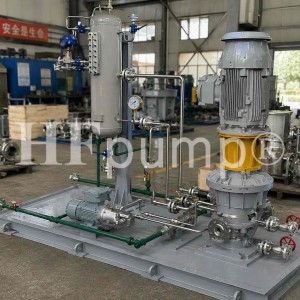
From a technical perspective, cavitation is not just a hydraulic phenomenon—it directly affects the impeller inlet edge, seal chamber, bearing system, and overall pump vibration. During selection, we typically focus on several key parameters: medium name, operating temperature, vapor pressure, inlet pressure, liquid level height, inlet pipe diameter, inlet pipeline length, filter pressure drop, normal flow rate, rated flow rate, minimum continuous stable flow, and the net positive suction head available (NPSHa).
The Jiangsu Haifa API 610 OH1/OH2 HES series petrochemical process pumps are horizontal, radially split, single-stage overhung centrifugal pumps with a flow range of 2–2600 m³/h, head up to 300 m, applicable temperature range of -80 to 450°C, and design pressure of 2.5–26 MPa. This series is commonly used in refineries, petrochemicals, low-temperature engineering, coal chemicals, chemical fibers, offshore industries, and seawater desalination plants. For stable liquid media, the OH2 pump is well-suited in terms of structure, maintenance, and seal configuration.
However, if the medium is prone to vaporization—such as liquefied gas, liquid ammonia, ethylene, condensate, or light hydrocarbons—we tend to consider the vertical API VS5/VS6 HVSD series more often. This series has a flow range of 215,000 m³/h, head up to 1000 m, applicable temperature range of -80 to 250°C, and design pressure up to 15 MPa. Its first-stage impeller is designed with a greater focus on cavitation performance, making it suitable for deep liquid levels, low-temperature media, easily vaporized media, and high-head applications. Often, choosing a vertical pump isn’t about “looking good”—it’s about creating better suction conditions at the pump inlet.
If the user requires high pressure, multi-stage, and continuous operation, we also consider BB3 or BB4 pumps depending on the conditions. The BB3 series is suitable for high-pressure pipeline transport, oilfield water injection, coal chemicals, and petrochemicals, with head up to 3000–3200 m and design pressure up to 35 MPa. The BB4 horizontal segmental multi-stage centrifugal pump has a head up to 1000 m and design pressure up to 15 MPa. The first-stage and subsequent-stage impellers are designed with different approaches—the first stage prioritizes cavitation performance, while the later stages focus on efficiency.
Personally, the biggest insight from international cavitation research is this: API 610 pump selection shouldn’t just chase a pretty efficiency curve—it also needs to ensure long-term stability in the field. Many customers only provide Q, H, temperature, and medium name, but that’s not enough. As long as the medium has a risk of vaporization, we must clarify NPSHa, vapor pressure, inlet pressure, inlet pipeline losses, and minimum continuous flow.
For refining and chemical plants, cavitation may start as just increased noise, but it can gradually develop into impeller pitting, pump vibration, bearing temperature rise, mechanical seal leakage, and eventually affect the continuous operation of the entire unit. So when recommending API 610 chemical process pumps, we prioritize safety margins rather than selecting pumps that are too small, too fast, or too close to the cavitation boundary.
If cavitation has already occurred at the user’s site, I generally suggest not rushing to replace the pump First, check whether the inlet filter is clogged, the inlet valve is fully open, the liquid level has dropped, the medium temperature has risen, there are air pockets in the pipeline, the pump is operating off its rated point. If these issues are ruled out and cavitation persists, then consider optimizing the impeller, reducing speed, switching to a double-suction design, adding an inducer, or choosing a VS5/VS6 vertical structure.
API 610 chemical process pump, centrifugal pump cavitation, NPSH, net positive suction head, OH2 centrifugal pump, BB2 process pump, VS6 vertical pump,PG pump, centrifugal pump cavitation, API 610 pump, chemical process pump, petrochemical pump, NPSH margin
上一篇:Should a screw pump or a centrifugal pump be chosen for oil-gas multiphase pumps? Jiangsu Haifa discusses pump selection from the perspective of API610 chemical process pumps 下一篇:When API610 chemical process pumps are used to transport media containing particles, how should the materials for the impeller and pump casing be selected
Jiangsu Haifa Machinery Manufacturing Co., Ltd.
📍 Headquarters: Jingjiang Economic and Technological Development Zone, Jiangsu Province (Yangtze River Delta Ecological Green Integration Demonstration Zone, Jingjiang Park)
📞 Hotline: (086)13905263417 & (086)13908365805
📠 Fax: (086)0523-84323581
📧 Email: jsareva@163.com jslgpump@gmail.com
🔧 Technical Support: One-stop service for pump & valve customization, non-standard design, on-site surveying, maintenance and repair
Member of China General Machinery Industry Association | Director of Valve Association | SINOPEC Resource Market Member Factory

Get QR Code