
How to choose a cryogenic and easily vaporizable medium pump? Jiangsu Haifa discusses the design approach of API610 pumps
2026-06-24 06:26:02 518 江苏海珐Media such as LNG, ethylene, liquid ammonia, LPG, light hydrocarbons, and condensate share a common characteristic in pump selection: they appear to be liquid but are actually highly prone to vaporization. As long as there is insufficient inlet pressure, liquid level fluctuations, or excessive pipeline pressure drop, bubbles may form at the pump inlet, leading to cavitation, pressure fluctuations, vibration, and unstable flow.
When we manufactured API610 chemical process pumps at Jiangsu Haifa, we never selected cryogenic pumps or pumps for easily vaporizing media based on the same approach as ordinary clean water pumps. The danger with such media lies not in "whether they can be pumped out," but in whether they can operate stably over the long term, whether the seal can remain safe, and whether there is sufficient Net Positive Suction Head Available (NHa) at the inlet.
Internationally, there is extensive research on LNG pump cavitation, cryogenic pumps, inducers, and pressure fluctuations, primarily focusing on two issues: how to reduce the risk of cavitation at the pump inlet, and how to control internal pressure fluctuations in cryogenic pumps.ucers are a common solution for improving suction performance, but they are not a cure-all. If the inlet conditions are poor and NPSHa itself is insufficient, relying solely on an inducer cannot fundamentally resolve cavitation.
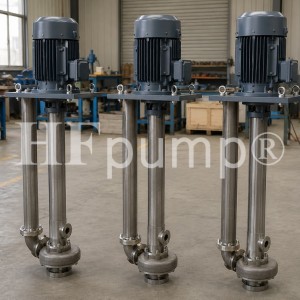
In our selection experience, for low-temperature, easily vaporizing media, the first considerations are the medium's saturation vapor pressure, operating temperature, inlet pressure, liquid level height, inlet pipeline losses, and pump installation method. If the liquid level is deep and suction conditions are tight, a vertical structure is often more suitable than a horizontal one. The API-VS5/VS6-HVSD series vertical multistage centrifugal pumps have a flow range of 2 to 15,000 m³/h a head of up to 1,000 m, an applicable temperature range of - to 250°C and a design pressure of up to 15 MPa. This series is suitable for refineries, petrochemical plants, coal chemical plants, cryogenic engineering, pipeline pressure regulation, condensate extraction, LPG engineering, offshore platforms, oil tankers, and other fields, particularly for media such as ethylene, liquid ammonia, LPG, condensate, hydrogen hydrocarbons, and oil products.
The of VS5/VS6 is not just "vertical installation." It can improve suction conditions through the submerged length, first-stage impeller design, and pump inlet arrangement. For low-temperature, easily vaporizing media, the pump inlet pressure is more critical than the outlet pressure. If the outlet head is insufficient, it can be adjusted by adding stages; but if the NPSHa is inadequate, even the largest pump is useless.
Of course, horizontal API610 pumps are also used for low-temperature media. The Jiangsu Haifa API610-OH1/OH2 HES series has an applicable temperature range of -80 to 450°C, a flow range of 2 2,600 m³/h, a head of up to 300 m, and a design pressure of 2.5 to 26 MPa. If the on-site inlet conditions are good and the liquid phase is stable, OH2 pumps can be for some low-temperature or easily vaporizing media processes. For low-flow applications, the HES(X) low-flow, high-head chemical process pump can also be considered, with flow range of 0.8 to 12.5 m³/h, a head of 12 to 125 m, and an applicable temperature range of -80 to 450°C.
Material selection is also critical for cryogenic pumps. Ordinary carbon steel may suffer from toughness issues at low temperatures, so austenitic stainless steel and other with better low-temperature performance are commonly used. Mechanical seals should not only consider the seal face material but also auxiliary flushing, cooling, venting, and seal chamber pressure control. For media such as LPG, light hydrocarbons, and ethylene, the seal system configuration often has a greater impact on safety than the pump body itself.
When designing cryogenic pump solutions, we recommend that users provide as complete data as possible: medium composition, operating temperature, inlet pressure, outlet pressure, liquid level height, vaporization pressure, density, viscosity, NPSHa, whether gas entrainment is present, whether operation is continuous, explosion-proof classification, and seal requirements. If only "LPG, flow rate, head" is provided, this data is insufficient for pump selection.
of cryogenic pumps usually does not happen suddenly. It may start with abnormal noise, slightly higher vibration, or flow fluctuations, followed by mechanical seal leakage, bearing temperature rise, and impeller cavitation damage. For media such as LNG, liquid ammonia, and LPG, pump issues are not just equipment problems—they directly affect plant safety.
Therefore, I believe that the key to selecting LNG cryogenic pumps and LPG pumps is not blindly pursuing high head or large motors, but rather considering NPSH, inducers, installation methods, vertical submerged structures, seal systems, and material combinations as a whole. The API610 standard provides a basic framework, but whether the pump can truly operate stably depends on the manufacturer's understanding of the working conditions.
LNG pump, cryogenic pump LPG pump, ethylene pump, liquid ammonia pump, condensate pump, API610 cryogenic pump, VS6 vertical pump, NPSH, inducer, cryogenic pump, LNG pump cavitation, vertical turbine pump, API 610 VS6 pump, LPG pump
上一篇:When API610 chemical process pumps are used to transport media containing particles, how should the materials for the impeller and pump casing be selected 下一篇:Research hotspots of oil-gas multiphase pumps: application boundaries of multiphase pumps, twin-screw pumps, and API610 centrifugal pumps
Jiangsu Haifa Machinery Manufacturing Co., Ltd.
📍 Headquarters: Jingjiang Economic and Technological Development Zone, Jiangsu Province (Yangtze River Delta Ecological Green Integration Demonstration Zone, Jingjiang Park)
📞 Hotline: (086)13905263417 & (086)13908365805
📠 Fax: (086)0523-84323581
📧 Email: jsareva@163.com jslgpump@gmail.com
🔧 Technical Support: One-stop service for pump & valve customization, non-standard design, on-site surveying, maintenance and repair
Member of China General Machinery Industry Association | Director of Valve Association | SINOPEC Resource Market Member Factory

Get QR Code