
Technical design scheme for OH2 high-temperature and high-pressure pump
2026-06-18 19:06:29 64 江苏海珐Technical Design Scheme for OH2 High-Temperature, High-Pressure Pump
Main Design Principles
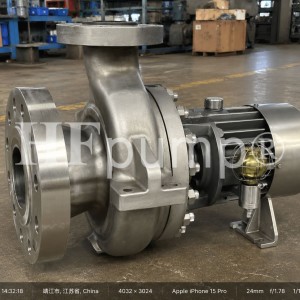
In this design, our company will focus on the following aspects:
Ensure that the pump casing, pump cover, and pressure-bearing components have sufficient safety margins under a 16MPa high-pressure working condition;
Control the impact of high-temperature media on the pump casing, pump cover, mechanical seal, bearing housing, and rotor system;
Reduce heat generation at the seal faces and the risk of localized vaporization of demineralized water;
Adopt a low-speed structure to improve the operational stability of the pump unit;
Effectively control axial thrust to reduce bearing load and the risk of rotor axial movement;
Meet the requirements for long-term operation and on-site maintenance convenience.2. Pump Type and Speed Design
For this working condition, our company recommends adopting a low-speed, high-temperature, high-pressure pump type, with the pump speed designed at 1450 r/min. Compared to high-speed pumps, low-speed pumps have lower impeller peripheral speeds, resulting in smoother operation, effectively reducing cavitation risk, vibration levels, bearing loads, and thermal load on mechanical seal faces. For the 330°C, 16MPa high-temperature, high-pressure demineralized water condition, a low-speed design is more conducive to long-term continuous operation of the pump unit and helps extend the service life of bearings, mechanical seals, couplings, and rotor components. Therefore, this project does not recommend using a high-speed, miniaturized pump type instead suggests a 1450 r/min low-speed, high-reliability design scheme.
Pressure-Bearing Component Design
The working pressure for this project reaches up to 16MPa. To ensure equipment operational safety, our company recommends designing, selecting materials, and performing strength checks for main pressure-bearing components such as the pump casing, pump cover, seal chamber, and inlet/outlet flanges at a pressure rating of no less than 25MPa. The pump casing and pump cover will be manufactured from high-strength pressure-bearing castings, with sufficient wall thickness and safety margins reserved in the structure. High-strength, high-pressure bolts will be used for the connection between the pump casing and pump cover, ensuring reliable connections under high temperature, high pressure, and temperature fluctuation conditions, thereby avoiding leakage risks due to thermal expansion, pressure fluctuations, or insufficient bolt preload. manufacturing, our company can conduct hydrostatic tests, non-destructive testing, and provide material certificates and related quality documents as per the technical agreement.
Mechanical Seal Design
Given the high temperature and high pressure of the medium in this condition, ordinary single-face mechanical seals or standard metal bellows mechanical seals pose risks such as seal face heating, medium vaporization, and seal failure. To address this, our company recommends adopting double-face high-pressure mechanical seal equipped with a PLAN 54 external pressurized circulation system. The PLAN 54 system cools, lubricates, and removes heat from the mechanical seal faces via an external pressurized circulating fluid, maintaining stable operation of the seal faces and the risk of localized vaporization of high-temperature demineralized water in the seal chamber. Additionally, the double-face seal structure enhances sealing safety; even if the inner seal face malfunctions, the outer seal and auxiliary system provide further protection. The mechanical seal is recommended be a high-pressure balanced cartridge type, with the seal faces, elastic elements, and auxiliary sealing materials specially selected for the 330°C, 16MPa condition, and the mechanical seal manufacturer should provide corresponding pressure and temperature range certifications and material certificates.
Cooling System DesignTo mitigate the impact of high-temperature media on key pump unit components, our company recommends configuring external cooling water for the following areas:
Pump casing cooling;
. Pump cover cooling;
Mechanical seal chamber cooling;
Bearing housing cooling.
By controlling temperatures in the pump casing, cover, seal chamber, and bearing housing with external cooling water, the operating environment for the mechanical seal and bearings can be effectively improved, reducing temperature rises at the seal faces and bearings, thereby enhancing the reliability of continuous pump unit operation. Cooling water interface, flow rate, and pressure requirements be further determined based on final pump structure and on-site conditions.
Axial Thrust Control Design
High-temperature, high-pressure pumps are prone to generating significant axial thrust during operation. Improper control may lead to increased bearing loads, rotor axial movement, and abnormal stress on mechanical seal faces. To address this, our will implement axial thrust control measures in the design, including:
Optimizing the hydraulic structure of the impeller;
Configuring balance holes, balance devices, or other axial thrust balancing structures based on the pump type;
Reasonably designing the rotor support structure;
Selecting bearing configurations suitable for high-temperature conditions;
dynamic balancing control on the rotor;
Controlling pump shaft deflection and runout values at the seal chamber.
Through these measures, bearing loads and the risk of rotor axial movement can be effectively reduced, ensuring stable stress on mechanical seal faces and improving the overall operational reliability of the pump unit.
Main Material Recommendations
Based on the current working conditions, company preliminarily recommends the following main materials:
Pump casing and pump cover: High-temperature, high-pressure-resistant pressure-bearing cast steel 316L material;
Impeller and guide vanes: 1Cr13 or higher-grade 316L material, corresponding to ASTM 420 stainless steel;
Pump shaft: High-stre, high-temperature-resistant shaft material;
. Mechanical seal: High-pressure balanced double-face cartridge mechanical seal;
Connection bolts: High-strength, high-pressure bolts;
Coupling: Diaphragm-type coupling;
Baseplate: Integral high-rigidity baseplate.
Final materials can be further confirmed based on your requirements for standards, corrosion allowance, non-destructive testing, and material certificates.
Operational Reliability Design
The pump unit for this project is designed for continuous operation. To enhance overall operational reliability, our company will implement controls in the following areas:
Adopt a 145 r/min low-speed design to reduce vibration and cavitation risks;
Configure a PLAN 54 double-face mechanical seal system to improve sealing safety;
Set up cooling structures for the pump casing, pump cover, seal chamber, and bearing housing;
Design and verify pressure-bearing components at a level higher than the actual working pressure;
Use high-strength bolts and reliable flange connection structures;
6 Implement specialized axial thrust control;
Perform dynamic balancing tests on the rotor;
Provide material certificates and quality inspection documents for key components.
Scheme Summary
In summary, for your 330°C, 16MPa high-temperature, high-pressure demineralized water working condition, our company recommends adopting a low-speed 1450 r/min high-temperature, high-pressure pump design scheme. This scheme centers on pressure-bearing safety, reliable sealing, adequate cooling, smooth operation, and controllable axial thrust. By employing a double-face high-pressure mechanical seal with PLAN 54, an external cooling water system, 25MPa-rated pressure-bearing component design, high-strength high-pressure bolts, a low-speed pump type and axial thrust control measures, risks such as seal failure, medium vaporization, vibration, bearing overload, and pressure-bearing component safety under high-temperature, high-pressure deminized water conditions can be effectively mitigated, ensuring long-term continuous and stable operation of the pump unit. Final design parameters, material configurations, cooling water interfaces, mechanical seal schemes, and testing requirements can be further confirmed through technical exchanges between both parties based on the final technical agreement.
上一篇:Analysis of the application of high-temperature magnetic pumps in large-scale refining, PTA, and coal chemical plants 下一篇:What should be considered when using pumps in parallel? Some experiences from our design of API610 chemical process pumps
Jiangsu Haifa Machinery Manufacturing Co., Ltd.
📍 Headquarters: Jingjiang Economic and Technological Development Zone, Jiangsu Province (Yangtze River Delta Ecological Green Integration Demonstration Zone, Jingjiang Park)
📞 Hotline: (086)13905263417 & (086)13908365805
📠 Fax: (086)0523-84323581
📧 Email: jsareva@163.com jslgpump@gmail.com
🔧 Technical Support: One-stop service for pump & valve customization, non-standard design, on-site surveying, maintenance and repair
Member of China General Machinery Industry Association | Director of Valve Association | SINOPEC Resource Market Member Factory

Get QR Code